Category: AI SEO Tools

  • How to Build an AI SEO Content Brief Workflow

    How to Build an AI SEO Content Brief Workflow

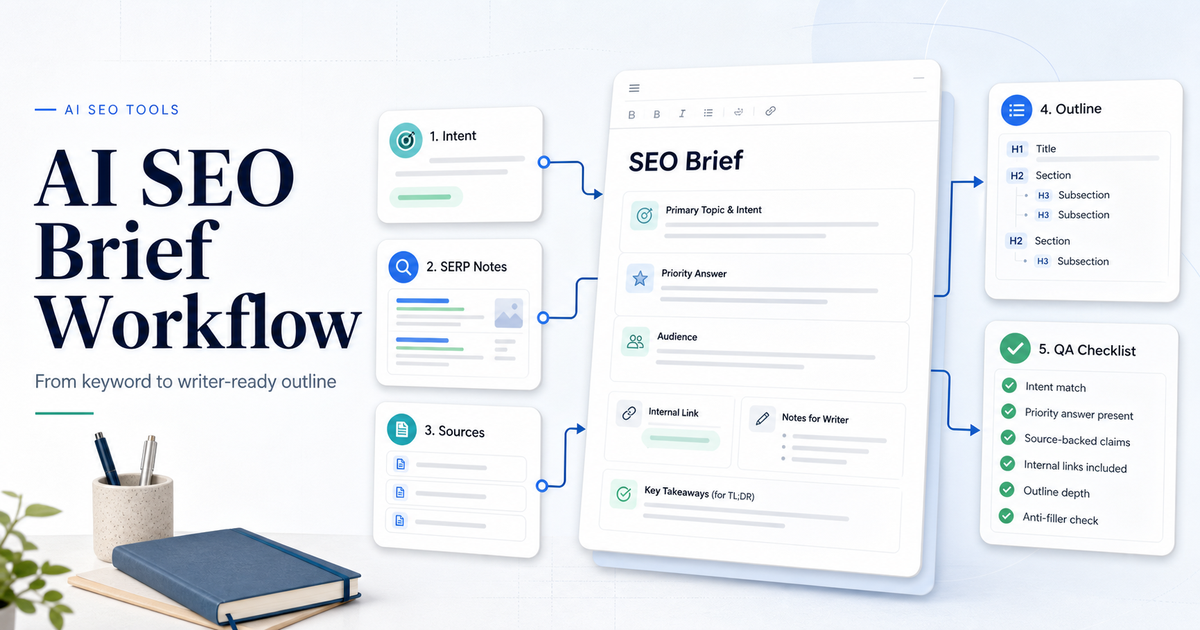
    An AI SEO content brief workflow helps a team move from keyword idea to writer-ready brief without turning SEO into a checklist of random keywords. The goal is to define search intent, gather source-backed requirements, outline the answer the article must provide, check competitor patterns, add internal-link opportunities, and give the writer enough direction to create a useful article.

    The best workflow uses AI to speed up research and structure, but it keeps editorial judgment in the loop. AI can suggest headings, questions, entities, and draft outlines. It should not decide the final angle alone. A strong SEO brief still needs a human to check intent, verify facts, remove filler, and decide what the reader needs first.

    If your team is comparing SEO tools first, our Surfer SEO vs Frase comparison is the right next read. If the brief is part of a larger research process, see our AI research workflow for teams.

    Quick Workflow Summary

    Step Purpose Output
    1. Confirm the keyword Make sure the topic is worth briefing Primary keyword and search intent
    2. Read the SERP Understand what Google is rewarding Content pattern notes
    3. Define the reader task Clarify what the article must answer Priority answer
    4. Collect source facts Avoid unsupported claims Source-backed notes
    5. Build the outline Give the writer a useful path H2 and H3 structure
    6. Add internal links Connect related site content naturally Link suggestions
    7. Create quality checks Prevent generic AI content Editorial checklist
    8. Review after draft Improve the brief based on output Updated process

    1. Confirm The Keyword And Intent

    Start by confirming the keyword, not by writing headings. A keyword such as “AI SEO content brief workflow” implies a process-led article. The reader wants to know how to build the workflow, what steps belong in it, which tools help, and how to avoid weak AI-generated briefs.

    Classify the intent before opening an AI tool:

    • Tutorial or workflow
    • Comparison
    • Review
    • Buyer guide
    • Pricing
    • Alternatives
    • Troubleshooting

    This matters because a workflow article should start with process and outcome. A comparison should start with verdict and tradeoffs. A buyer guide should start with recommendations. If the brief format does not match intent, the article feels wrong even if the keywords are present.

    2. Read The SERP Without Copying It

    An SEO brief should learn from top-ranking pages without copying their structure blindly. Look for repeated patterns:

    • What problem does each page solve?
    • What sections appear near the top?
    • What questions are repeated?
    • What examples or tables help the reader?
    • What information is missing?
    • Where do pages become thin or generic?

    Google’s SEO Starter Guide emphasizes making content easier for search engines to crawl, index, and understand. A content brief should support that goal by making the article clear, structured, and useful for the reader.

    Do not treat the SERP as a template library. The job is to understand expectations and find a better angle.

    3. Define The Priority Answer

    Every SEO brief should tell the writer what answer belongs near the top. This is where many AI-generated briefs fail. They list headings before defining the reader’s main job.

    For a workflow article, the priority answer might be:

    “An AI SEO content brief workflow should confirm search intent, analyze the SERP, collect source-backed facts, create a writer-ready outline, add internal links, and include quality checks before drafting begins.”

    That answer should appear early in the article. The rest of the brief supports it.

    4. Use SEO Tools For Research And Structure

    Surfer’s Content Editor is designed to help with content research, outline creation, recommended entities and facts, and optimization progress. Surfer’s documentation also describes a Content Editor workflow that includes competitor exploration, questions, notes, outline work, and writing/optimization.

    Frase positions itself as an SEO and GEO platform that researches markets, creates optimized content, tracks visibility across Google and AI search engines, and supports competitive research and content creation.

    Semrush Content Toolkit combines AI writing capabilities with Semrush SEO data for content work. Semrush’s knowledge base also describes content workflows that move from idea to publication.

    Use these tools to speed up research, but do not let any tool decide the article without review. SEO tools can reveal patterns. Editors decide what belongs in the final brief.

    5. Build The Writer-Ready Outline

    A writer-ready outline should include more than headings. Each section should explain what the writer must accomplish.

    Good brief format:

    • H2 title
    • Purpose of the section
    • Key points to cover
    • Source notes
    • Internal link opportunity
    • Example or table idea
    • What to avoid

    For example:

    Section Purpose Writer Notes
    Quick Workflow Summary Answer the intent early Include the full process in a table
    Confirm Keyword And Intent Prevent wrong article format Explain intent types and priority answer
    SERP Review Use competitors responsibly Learn patterns without copying
    Source Facts Keep claims safe Use official sources for tools and SEO guidance
    Quality Checks Prevent generic AI output Include human review and anti-filler checks

    This gives the writer direction without forcing a rigid template.

    6. Add Source Requirements

    AI can produce confident but unsupported claims. The brief should name which claims need sources before writing begins.

    Source requirements may include:

    • Official tool pages for features
    • Official pricing pages if pricing is discussed
    • Official documentation for platform limits
    • Google Search Central for SEO principles
    • Company help centers for product workflows
    • Existing internal articles for related context

    Do not ask writers to “add sources later.” The brief should identify source needs early so unsupported claims do not enter the draft.

    7. Add Internal Link Opportunities

    Internal links should be chosen before drafting, then inserted naturally where they help the reader. Do not add random internal links just to increase link count. A good internal link gives the reader a useful next step. It should fit the paragraph naturally, use a clean slug URL, and avoid repeated anchors.

    8. Include An Anti-Filler Checklist

    AI SEO briefs often become bloated. Add checks that prevent weak content:

    • Does the article answer intent in the first 150 to 250 words?
    • Does each section have a job?
    • Are there unsupported tool claims?
    • Are pricing claims verified or omitted?
    • Are examples realistic without fake statistics?
    • Are FAQs distinct?
    • Is the conclusion specific?
    • Are internal links natural?
    • Are external links official where needed?

    This checklist protects article quality before the draft reaches QA.

    9. Draft, Review, And Improve The Brief

    The brief should improve after the first draft. If the writer gets stuck, the brief may be too vague. If the draft repeats generic sections, the brief may need stronger section purposes. If the article misses the priority answer, the brief did not make the answer clear enough.

    Review the draft against the brief:

    • Did the writer answer the main intent early?
    • Did the article use source-backed claims?
    • Did the outline fit the topic?
    • Did the article avoid generic AI phrasing?
    • Did internal links fit naturally?
    • Did the conclusion give a clear recommendation?

    Then update the brief template so the next article is easier to write.

    AI SEO Content Brief Template

    Use this template:

    1. Topic title 2. Primary keyword 3. Search intent 4. Priority answer 5. Target reader 6. Required sources 7. Tools mentioned 8. Suggested internal links 9. Recommended structure 10. Section-by-section notes 11. Examples or tables needed 12. Claims to avoid 13. FAQ candidates 14. Final recommendation angle 15. QA checklist

    This is enough structure to guide the writer without turning every article into the same template.

    Final Recommendation

    Use AI and SEO tools to speed up content brief research, but keep the final brief editorial. The strongest AI SEO content brief workflow confirms intent, studies the SERP, defines the priority answer, gathers sources, creates a section-by-section outline, adds natural internal links, and includes quality checks before drafting begins.

    If your team only does one thing, make the priority answer mandatory. It keeps the article useful from the beginning and prevents generic introductions.

    FAQs

    What is an AI SEO content brief?

    An AI SEO content brief is a writer-ready plan that uses AI and SEO research to define search intent, outline structure, source needs, internal links, examples, FAQs, and quality checks before drafting.

    Which tools can help create SEO content briefs?

    Surfer, Frase, Semrush Content Toolkit, and general AI assistants can help with research, outlines, questions, entities, and draft structure. A human editor should still approve the final brief.

    Should AI write the whole SEO brief?

    AI can draft a brief, but it should not be the only reviewer. Editors need to check intent, source quality, internal links, section usefulness, and unsupported claims.

    What should every SEO brief include?

    Every SEO brief should include a primary keyword, search intent, priority answer, target reader, outline, source requirements, internal link opportunities, FAQ candidates, and quality checklist.

    How long should an SEO content brief be?

    The brief should be long enough to guide the writer but not so long that it becomes harder than the article. A practical brief usually fits into a few structured pages or a concise project document.

    How do internal links fit into a content brief?

    Internal links should be planned before drafting and inserted only where they help the reader. Use clean final URLs and natural anchor text.

    Can SEO tools replace human keyword judgment?

    No. SEO tools can surface patterns, questions, entities, and optimization suggestions, but humans still need to judge intent, usefulness, and brand fit.

    What is the biggest mistake in AI SEO briefs?

    The biggest mistake is generating a long outline without defining the priority answer. The writer needs to know what the article must answer first.

    Should pricing be included in an SEO brief?

    Only include pricing when official pricing sources are available and pricing matters to search intent. Otherwise, do not force pricing into the article.

    How do you prevent generic AI SEO content?

    Use specific search intent, source requirements, practical examples, internal links, clear section purposes, and a human review checklist before publishing.
  • Surfer SEO vs Frase: Which AI SEO Tool Should You Choose?

    Surfer SEO vs Frase: Which AI SEO Tool Should You Choose?

    Surfer SEO vs Frase is a workflow decision for content teams, SEO writers, agencies, and site owners who need help turning search intent into better-structured content. Both tools sit in the SEO content optimization category, but the buying decision depends on how you research, brief, write, optimize, and update articles. This article focuses on verified product positioning, official website links, official pricing pages, and practical buyer questions. It does not claim hands-on testing.

    You can review Surfer SEO and Frase from their official websites before making a final decision.

    Quick Workflow Verdict

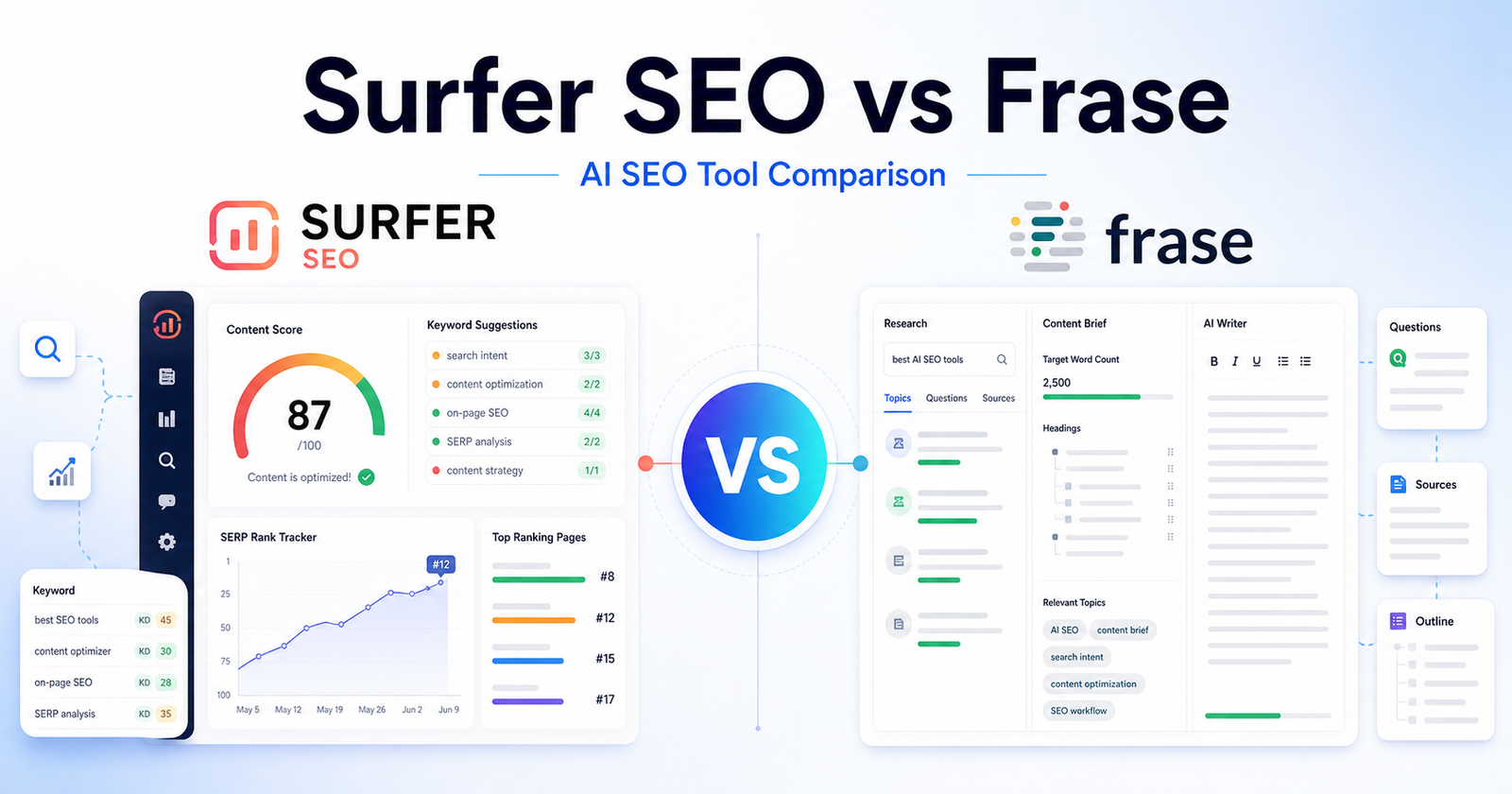
    Choose Surfer SEO if your main bottleneck is optimizing content against SERP-driven recommendations and giving writers clear SEO direction. Choose Frase if your main bottleneck is research, brief creation, and moving from query to outline to draft more quickly.

    The fastest way to decide is to map each product to one real task. If the tool makes that task easier without adding heavy cleanup, it may be the better choice. If the output still needs too much manual review, the stronger feature list may not matter.

    How Each Tool Fits an SEO Content Workflow

    Surfer SEO is positioned around content optimization and SEO workflows that help writers and teams improve content using data-led recommendations.

    Frase is positioned around researching, outlining, writing, and optimizing SEO content with AI-assisted content workflows.

    The difference matters because buyers often compare tools only by feature names. A better comparison asks where each product sits in the workflow, who reviews the output, how pricing limits affect regular use, and whether the tool fits solo work, team workflows, or agency delivery.

    Surfer SEO vs Frase: Quick Comparison

    Comparison Point Surfer SEO Frase
    Main category Surfer SEO is used for ai seo tools workflows. Frase is used for ai seo tools workflows.
    Best fit Choose Surfer SEO if your main bottleneck is optimizing content against SERP-driven recommendations and giving writers clear SEO direction. Choose Frase if your main bottleneck is research, brief creation, and moving from query to outline to draft more quickly.
    Primary workflow Surfer SEO is positioned around content optimization and SEO workflows that help writers and teams improve content using data-led recommendations. Frase is positioned around researching, outlining, writing, and optimizing SEO content with AI-assisted content workflows.
    Beginner fit Good when the user follows the product workflow and checks official guidance. Good when the user follows the product workflow and checks official guidance.
    Team fit Surfer SEO may fit SEO teams and agencies that need repeatable optimization guidance. Frase may fit editorial teams that need faster briefs and research handoff. Surfer SEO may fit SEO teams and agencies that need repeatable optimization guidance. Frase may fit editorial teams that need faster briefs and research handoff.
    Agency fit Agencies should compare the number of client projects, writers, content editors, and workflow limits on official pricing pages before choosing. Agencies should compare the number of client projects, writers, content editors, and workflow limits on official pricing pages before choosing.
    Pricing transparency Official pricing URL is provided; exact plan data is not included in this draft. Official pricing URL is provided; exact plan data is not included in this draft.
    Free access Not included because free-plan status was not captured as table-safe pricing data. Not included because free-plan status was not captured as table-safe pricing data.
    Setup effort Depends on account setup, workflow complexity, and team requirements. Depends on account setup, workflow complexity, and team requirements.
    Best evaluation method Run one realistic project and measure cleanup time. Run one realistic project and measure cleanup time.
    Main risk Buying before checking current limits and workflow fit. Buying before checking current limits and workflow fit.
    Support/documentation Use official docs, help center, and pricing page for current details. Use official docs, help center, and pricing page for current details.
    Solo users Frase may feel more practical for solo writers who want research and outline help in one place, while Surfer SEO may justify itself when optimization quality matters more than draft speed. Frase may feel more practical for solo writers who want research and outline help in one place, while Surfer SEO may justify itself when optimization quality matters more than draft speed.
    Businesses Agencies should compare the number of client projects, writers, content editors, and workflow limits on official pricing pages before choosing. Agencies should compare the number of client projects, writers, content editors, and workflow limits on official pricing pages before choosing.
    Final recommendation Choose Surfer SEO if your main bottleneck is optimizing content against SERP-driven recommendations and giving writers clear SEO direction. Choose Frase if your main bottleneck is research, brief creation, and moving from query to outline to draft more quickly. Choose Surfer SEO if your main bottleneck is optimizing content against SERP-driven recommendations and giving writers clear SEO direction. Choose Frase if your main bottleneck is research, brief creation, and moving from query to outline to draft more quickly.

    Pricing Comparison

    Surfer and Frase both publish detailed plan pricing, but the plans are structured differently. Surfer separates plans around documents, AI visibility tracking, team seats, and enterprise SEO controls. Frase includes its full AI Agent across plans and scales by articles, seats, domains, and automation depth.

    Pricing Point Surfer SEO Frase
    Free plan No free plan listed as a core paid tier. No free plan listed as a core paid tier.
    Free trial Start-for-free option appears on paid plan cards. 7-day free trial with full access and no credit card required.
    Cheapest paid plan Discovery at $49/month billed yearly. Starter at $39/month billed yearly.
    Monthly pricing Standard $119/month, Pro $219/month, Peace of Mind $359/month when billed monthly. Starter $49/month, Professional $129/month, Scale $299/month when billed monthly.
    Annual pricing Discovery $49/month, Standard $99/month, Pro $182/month, Peace of Mind $299/month when billed yearly. Starter $39/month, Professional $103/month, Scale $239/month when billed yearly.
    Annual discount Annual billing shows savings such as $240 on Standard, $444 on Pro, and $720 on Peace of Mind. Annual billing saves 20%.
    Entry plan limits Discovery includes 120 documents and 10 tracked pages. Starter includes 10 articles per month.
    Mid-tier limits Standard includes 360 documents, AI visibility tracking, and 25 AI prompts refreshed weekly. Professional includes 3 seats, 5 domains, and 40 articles per month.
    Advanced plan limits Pro includes 360 documents, 50 AI prompts refreshed daily, and 5 brand workspaces. Scale includes 5 seats, 10 domains, and 100 articles per month.
    Highest listed plan Peace of Mind at $299/month billed yearly; Enterprise starts at $999/month. Scale at $239/month billed yearly.
    Team seats Discovery 1 seat, Standard 3 seats, Pro 5 seats, Peace of Mind 10 seats. Professional 3 seats, Scale 5 seats.
    Enterprise/custom pricing Enterprise starts at $999/month with tailored packages. No custom enterprise price shown in the captured pricing table.
    Official pricing page Surfer pricing Frase pricing

    Plan-by-Plan Pricing

    Tool Plan Monthly Price Annual Price Best For Key Limits
    Surfer Discovery Not listed in the captured monthly plan set $49/month billed yearly Testing Surfer and baseline optimization 120 documents, 10 tracked pages
    Surfer Standard $119/month $99/month billed yearly Small teams building AI search visibility 360 documents, 25 AI prompts refreshed weekly, 3 team seats
    Surfer Pro $219/month $182/month billed yearly Teams managing authority and internal linking 360 documents, 50 AI prompts refreshed daily, 5 brand workspaces
    Surfer Peace of Mind $359/month $299/month billed yearly High-volume SEO teams Unlimited documents, API access, 10 team seats
    Surfer Enterprise From $999/month From $999/month Large teams needing advisory and security controls Custom limits, SSO, onboarding, priority support
    Frase Starter $49/month $39/month billed yearly Solo content creators 10 articles/month, AI visibility tracking, site audits, API access
    Frase Professional $129/month $103/month billed yearly Content teams and growing brands 3 seats, 5 domains, 40 articles/month
    Frase Scale $299/month $239/month billed yearly Agencies and high-volume teams 5 seats, 10 domains, 100 articles/month, automation

    Frase has the lower entry price for solo content teams. Surfer becomes more attractive when AI visibility tracking, internal linking, brand workspaces, and enterprise SEO controls matter more than entry price.

    Pricing last checked: June 12, 2026. For the latest details, visit the Surfer official pricing page and Frase official pricing page.

    Research and Brief Creation

    Surfer SEO is usually evaluated by how well it guides optimization decisions after a target keyword or content brief is already in motion. Frase is usually evaluated by how well it helps the writer move from research to outline to draft. For SEO teams, the better workflow depends on where the bottleneck happens.

    A good evaluation project should be small but realistic. Use the same brief, same audience, same constraints, and same quality bar in both tools. Then compare setup time, editing time, final quality, and whether the paid plan would remove enough friction to be worth it.

    Content Optimization Experience

    Surfer SEO may be the better fit when the team wants stronger optimization direction. Frase may be the better fit when research, headings, and brief creation are the slower parts of the process. Both still require editorial judgment because SEO recommendations should support search intent, not replace expertise.

    A good evaluation project should be small but realistic. Use the same brief, same audience, same constraints, and same quality bar in both tools. Then compare setup time, editing time, final quality, and whether the paid plan would remove enough friction to be worth it.

    Where Each Tool Can Slow You Down

    Surfer SEO can slow users down if they treat optimization scores as the whole strategy. Frase can slow users down if generated outlines are accepted without checking search intent, brand voice, and factual accuracy.

    A good evaluation project should be small but realistic. Use the same brief, same audience, same constraints, and same quality bar in both tools. Then compare setup time, editing time, final quality, and whether the paid plan would remove enough friction to be worth it.

    Best Choice by User Type

    Choose Surfer SEO If

    • You prefer the workflow described by the official Surfer SEO product pages.
    • Your main use case matches the strongest reasons to choose Surfer SEO.
    • You have checked the official pricing page and plan limits.
    • You can review the output before using it in public-facing work.

    Choose Frase If

    • You prefer the workflow described by the official Frase product pages.
    • Your team needs the kind of output and controls Frase is built around.
    • The current pricing page fits your usage volume.
    • You want a tool that better matches your team, client, or content process.

    Consider Alternatives If

    Consider alternatives if neither tool clearly fits your budget, output quality requirements, workflow, or governance needs. A cheaper tool can become expensive if it creates more review work. A more expensive tool can be worthwhile if it saves time across repeated projects.

    Final Recommendation

    Choose Surfer SEO if your main bottleneck is optimizing content against SERP-driven recommendations and giving writers clear SEO direction. Choose Frase if your main bottleneck is research, brief creation, and moving from query to outline to draft more quickly.

    For most buyers, the best next step is not to read another feature list. It is to choose one real project, run the same brief through both tools, compare cleanup time, and check current official pricing. The better tool is the one that gives you a usable result with fewer corrections, clearer limits, and a plan that matches your real usage.

    FAQs

    Is Surfer SEO better than Frase?

    Surfer SEO is better if its workflow matches your main use case and pricing limits. Frase is better if its workflow fits your team, output needs, and budget more closely.

    Is Frase better than Surfer SEO?

    Frase can be better for users who need its specific strengths. The safest answer is to test both with the same realistic project and compare final quality, cleanup time, and current plan limits.

    Which tool is cheaper?

    Do not rely on old pricing screenshots or third-party summaries. Check the official Surfer SEO pricing page and official Frase pricing page before choosing because plan limits and prices can change.

    Does either tool have a free plan?

    Free access should be confirmed on the official pricing pages. If a free plan, trial, or limited account exists, check what features, exports, seats, and usage limits are included.

    Which tool is better for solo users?

    Frase may feel more practical for solo writers who want research and outline help in one place, while Surfer SEO may justify itself when optimization quality matters more than draft speed.

    Which tool is better for teams?

    Surfer SEO may fit SEO teams and agencies that need repeatable optimization guidance. Frase may fit editorial teams that need faster briefs and research handoff.

    Which tool is better for agencies?

    Agencies should compare the number of client projects, writers, content editors, and workflow limits on official pricing pages before choosing.

    What should I check before buying?

    Review the current plan price, usage limits, seats, export options, collaboration features, security terms, and whether Surfer SEO or Frase supports your real workflow.

    Can I use both tools together?

    Yes, but only if each tool handles a different job. Paying for both Surfer SEO and Frase makes sense only when the combined workflow saves more time than it costs.

    If your SEO workflow also needs AI writing support, our Copy AI vs Jasper AI comparison and Grammarly vs QuillBot comparison comparisons can help complete the content stack.

    Which tool should I choose first?

    Start with the tool that solves your biggest bottleneck. Choose Surfer SEO if your main bottleneck is optimizing content against SERP-driven recommendations and giving writers clear SEO direction. Choose Frase if your main bottleneck is research, brief creation, and moving from query to outline to draft more quickly.