Tag: AI Meeting Assistants

  • Otter.ai vs Fathom: Which AI Meeting Assistant Should You Choose?

    Otter.ai vs Fathom: Which AI Meeting Assistant Should You Choose?

    Quick Verdict

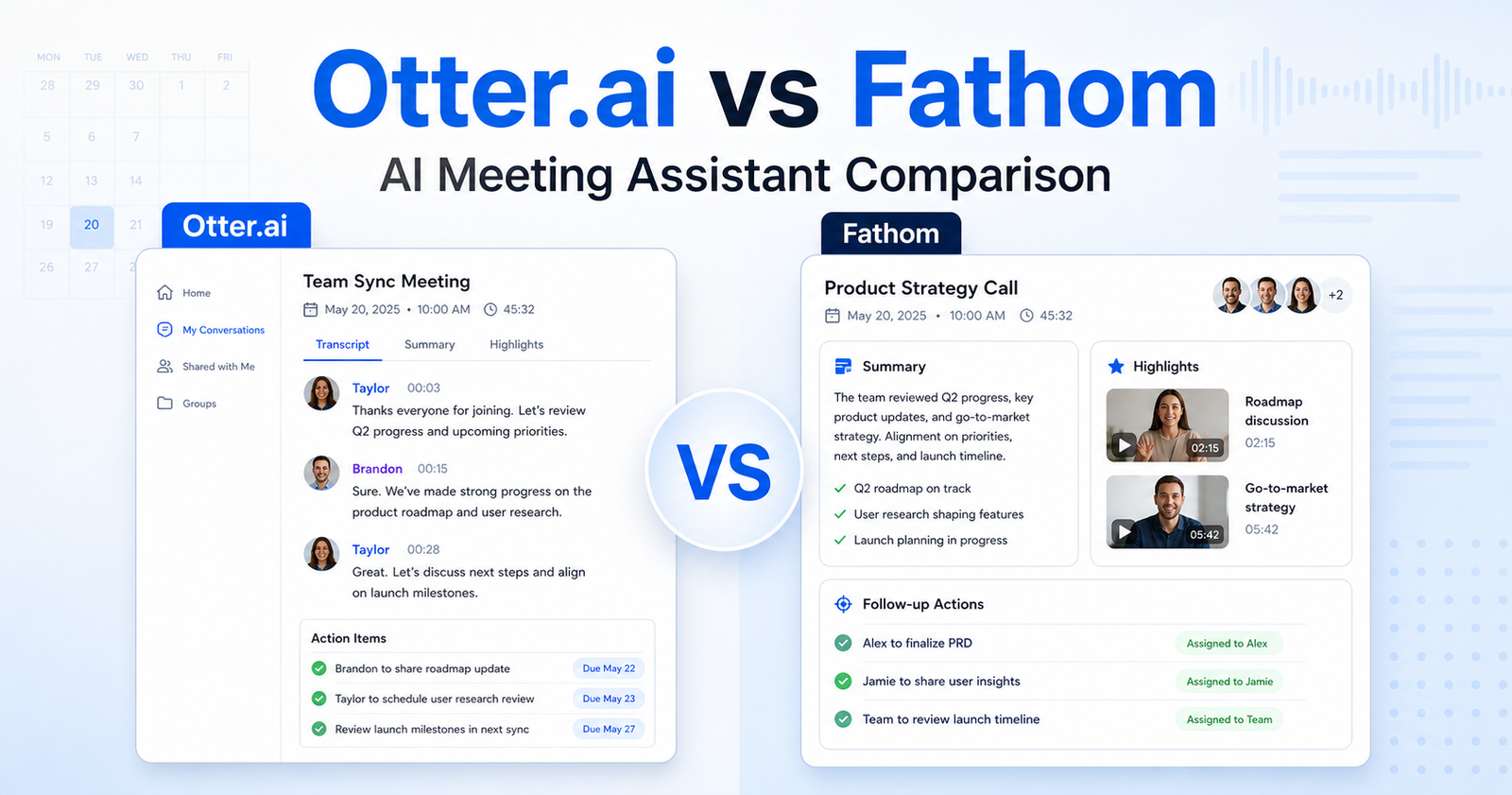
    Choose Otter.ai if your team needs live transcription, searchable meeting records, shared vocabulary, exports, and broader admin controls across Zoom, Google Meet, and Microsoft Teams. Choose Fathom if your main goal is faster meeting capture with unlimited recordings, clean AI summaries, clips, playlists, and simple follow-up workflows.

    For most small teams, Fathom is easier to adopt because its free plan includes unlimited recordings and transcription. Otter.ai is better when transcription depth, import limits, conversation history, vocabulary, and enterprise controls matter more than simplicity.

    If you are comparing meeting assistants more broadly, our Otter.ai vs Fireflies.ai comparison is a useful next read. If your team already has call summaries but needs a repeatable follow-up process, see our AI meeting notes workflow.

    Quick Comparison

    Decision Point Otter.ai Fathom
    Best for Teams that need live notes, exports, admin controls, and searchable transcripts Teams that want fast meeting summaries, clips, and lightweight sharing
    Free plan Basic plan with 300 monthly transcription minutes and recent conversation history limits Free forever plan with unlimited recordings and transcriptions
    Meeting capture Joins Zoom, Google Meet, and Microsoft Teams Records meetings and supports bot-free capture in beta
    Summaries Automated summaries, action items, outlines, and AI chat Instant AI summaries, advanced summaries on paid plans, and action items
    Collaboration Folders, sharing, comments, annotations, team vocabulary, and admin features by plan Shared call search, comments, folders, keyword alerts, playlists, and team features
    Sales workflow fit Stronger at higher tiers because of Salesforce, HubSpot, API, and webhooks Strong for sales teams that use clips, CRM sync, coaching metrics, and deal views
    Ease of adoption More controls, but more plan limits to understand Simpler for individuals and teams that want quick meeting capture
    Not the right choice if You need unlimited free transcription minutes You need deeper transcript governance and enterprise controls from day one
    Final recommendation Best for structured meeting documentation and larger-team controls Best for fast meeting capture and shareable follow-up moments

    Pricing Comparison

    Pricing sources checked: 2026-06-15. Sources: Otter.ai official pricing page and Fathom official pricing page.

    Pricing Point Otter.ai Fathom
    Free plan Basic is free Free plan is $0 and free forever
    Individual paid plan Pro is $16.99 per user/month monthly, or $8.33 per user/month annually Premium is $20 per user/month monthly, or $16 per user/month annually
    Team plan Business is $30 per user/month monthly, or $19.99 per user/month annually Team is $19 per user/month monthly, or $15 per user/month annually, with a 2-user minimum
    Higher team plan Enterprise uses demo/contact sales Business is $34 per user/month monthly, or $25 per user/month annually, with a 2-user minimum
    Free transcription 300 monthly transcription minutes on Basic Unlimited recordings and transcriptions on Free
    File imports Basic includes 3 lifetime audio/video imports; Pro includes 10 monthly imports Free and paid plans focus on unlimited recordings and transcription
    Meeting length limits Basic 30 minutes, Pro 90 minutes, Business 4 hours Pricing page highlights unlimited recording/transcription, with paid summaries and team controls
    Team collaboration Business adds admin features, usage analytics, concurrent meetings, and prioritized support Team adds shared search, playlists, comments, folders, keyword alerts, and SSO
    Sales/CRM Pro mentions Salesforce, HubSpot, and Zapier subject to limits; Enterprise adds custom integrations/API/webhooks Business adds CRM field sync, deal view, coaching metrics, and AI scorecards
    Trial/guarantee Otter provides free plan and paid buy-now paths Fathom paid plans list free trial CTAs and a 90-day guarantee
    Enterprise Custom demo path with SSO, SCIM, domain capture, security controls, HIPAA add-on, API and webhooks Business plan is listed publicly; sales contact is available for larger needs

    What Otter.ai Does Better

    Otter.ai is built around meeting records. The official pricing page lists live transcription, speaker identification, audio playback, multi-language support, AI chat across meetings, meeting templates, exports, and admin controls across paid tiers. That makes it stronger when a team treats meeting notes as a searchable knowledge base, not just a follow-up summary.

    The practical advantage is control. A manager who runs weekly client calls can search transcripts, export notes, tag speakers, and maintain vocabulary for product names or client terminology. A sales team can also value the higher-tier integrations with Salesforce, HubSpot, Zapier, API, and webhooks when those are available on the right plan.

    Otter.ai is not the right choice if your main frustration is simply, "I want every call recorded and summarized without thinking about minutes." Its free plan is useful, but it has transcription and history limits. Teams with high meeting volume should study the plan limits before standardizing on it.

    What Fathom Does Better

    Fathom is stronger for quick capture and follow-through. Its official pricing page highlights unlimited recordings and transcriptions on the free plan, instant AI summaries, clips, playlists, search across calls, advanced summaries, AI-generated action items, a conversational meeting assistant, and team collaboration features on paid plans.

    That makes Fathom a better fit for sales calls, customer interviews, user research calls, internal check-ins, and founder-led meetings where the goal is to turn a conversation into shareable moments and next steps. A small agency running discovery calls could use clips and summaries to send useful recaps without building a heavier documentation system.

    Fathom is not the right choice if your team needs deeper transcript governance, detailed export control, complex enterprise compliance, or a meeting archive that behaves like a formal company knowledge base. It can still work, but Otter.ai usually offers more visible controls for that use case.

    Common Mistakes When Choosing

    The first mistake is choosing based only on summary quality. Both tools can summarize meetings, but teams usually fail because they do not define what happens after the summary. If action items are not routed, reviewed, and assigned, the best summary still becomes another forgotten note.

    The second mistake is ignoring limits. Otter.ai has detailed limits around transcription minutes, meeting length, imports, vocabulary, AI chat queries, exports, and admin features by plan. Fathom has simpler capture positioning, but team features, CRM workflows, and advanced summary controls still sit behind paid plans.

    The third mistake is treating every meeting the same. Recruiting, sales, customer success, and internal standups need different templates. Pick the tool that supports your highest-volume meeting type first.

    Choose Otter.ai If

    • You need live transcription and meeting notes across Zoom, Microsoft Teams, and Google Meet.
    • Your team cares about transcript history, exports, search, vocabulary, and speaker labels.
    • Admin controls, analytics, SSO, SCIM, domain capture, API, webhooks, or compliance add-ons matter.
    • You want a meeting knowledge base that can be searched after the call.

    Choose Fathom If

    • You want a generous free meeting assistant for recording, transcription, and summaries.
    • Your team values clips, playlists, highlight sharing, and fast follow-ups.
    • Sales or customer teams need easy call recaps and CRM-friendly notes.
    • You want less setup friction and fewer limits on basic capture.

    Final Recommendation

    Otter.ai is the better choice for teams that need structured meeting documentation, searchable transcripts, exports, and stronger controls. Fathom is the better choice for individuals and teams that want fast AI meeting capture, summaries, clips, and practical follow-up workflows without heavy setup.

    If you are a small team choosing today, start with Fathom if unlimited free capture is the deciding factor. Choose Otter.ai if transcripts, governance, exports, and admin depth will matter as your meeting archive grows.

    FAQs

    Is Otter.ai better than Fathom?

    Otter.ai is better for structured transcription, searchable meeting history, exports, admin controls, and enterprise-style meeting documentation. Fathom is better for simple meeting capture, unlimited free recordings and transcriptions, AI summaries, clips, and follow-up sharing.

    Is Fathom really free?

    Fathom lists a free forever plan at $0 with unlimited recordings and transcriptions on its official pricing page. Paid plans add Premium, Team, and Business features such as advanced summaries, AI action items, collaboration, CRM field sync, and coaching metrics.

    Does Otter.ai have a free plan?

    Yes. Otter.ai lists a Basic free plan with live transcription, AI chat, meeting workflows, mobile apps, and 300 monthly transcription minutes. Paid plans raise limits and add collaboration, exports, integrations, admin controls, and enterprise options.

    Which tool is better for sales teams?

    Fathom is often easier for sales teams that want clips, summaries, CRM sync, coaching metrics, and call highlights. Otter.ai can be stronger when sales notes need to live inside a broader transcript archive with exports, vocabulary, and admin controls.

    Which tool is better for agencies?

    Small agencies that want quick client call summaries may prefer Fathom. Agencies that need searchable archives, transcript exports, speaker tagging, and formal documentation across many clients may prefer Otter.ai.

    Can either tool replace project management?

    No. These tools help capture meetings and summarize decisions. They do not replace a task system. A good workflow still sends action items into tools like Asana, ClickUp, Trello, Notion, or a CRM.

    What matters more than the AI summary?

    The follow-up workflow matters more. Decide where action items go, who reviews the summary, how transcript corrections are handled, and when the team deletes or archives sensitive recordings.

  • How to Build an AI Meeting Notes Workflow: Capture, Summarize, Assign, Follow Up

    How to Build an AI Meeting Notes Workflow: Capture, Summarize, Assign, Follow Up

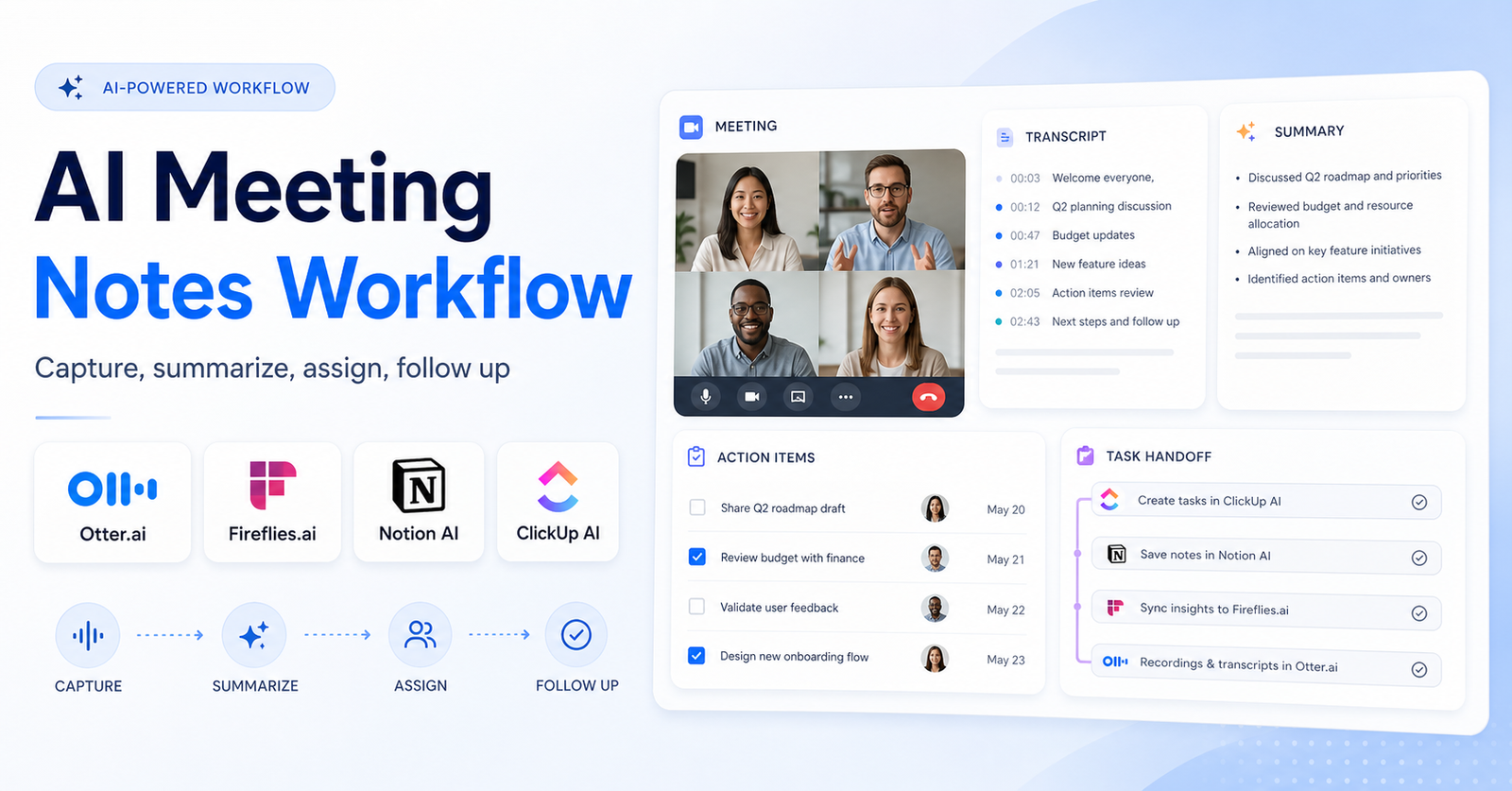
    An AI meeting notes workflow helps teams turn conversations into useful follow-up work. The goal is not just to record a transcript. The real value comes from capturing the meeting, summarizing decisions, assigning action items, sending follow-ups, and keeping the notes connected to the tools your team already uses.

    This matters because meetings often create hidden work. Someone promises to send a proposal. Someone else agrees to update a roadmap. A customer raises a risk. A manager asks for a decision by Friday. If those details stay buried in a call recording, the meeting still creates friction.

    A good workflow uses AI meeting assistants such as Otter.ai and Fireflies.ai for capture and summaries, then routes important notes into tools such as Notion AI, ClickUp AI, or your project management system. If you are deciding between the two main meeting assistants first, read our Otter.ai vs Fireflies.ai comparison. This guide focuses on the workflow around those tools.

    Quick Workflow Summary

    Step Purpose Output
    1. Define meeting types Decide which calls need AI notes Recording and note policy
    2. Capture the meeting Record transcript and speakers Searchable meeting record
    3. Generate a summary Extract decisions and key points Short team-readable notes
    4. Pull action items Identify owners, due dates, and next steps Task-ready checklist
    5. Store source notes Keep context in a shared workspace Reusable knowledge base
    6. Assign work Move tasks into the execution tool Clear owner and deadline
    7. Review and improve Check accuracy and close the loop Cleaner follow-up system

    1. Decide Which Meetings Need AI Notes

    Not every meeting needs a full AI notes workflow. Start by choosing which meeting types are worth capturing. Sales calls, customer onboarding sessions, hiring interviews, strategy meetings, product reviews, and recurring project check-ins usually benefit the most.

    For low-value calls, AI notes can create more noise than clarity. A short internal sync may only need a manual decision note. A client call with pricing, deadlines, objections, and commitments probably deserves a transcript, summary, and action-item workflow.

    Create a simple policy before connecting tools:

    • Which meetings can be recorded
    • Who should be notified before recording
    • Where transcripts and summaries are stored
    • Which meetings require human review
    • Who owns action-item cleanup
    • How long meeting records should be retained

    This makes the workflow more reliable and avoids treating AI recording as an afterthought.

    2. Capture The Meeting With The Right Tool

    The capture tool should fit the meeting environment. Otter.ai is commonly used for recording, transcription, summaries, and collaboration around meeting notes. Fireflies.ai is also built for meeting transcription, summaries, search, and workflow integrations.

    The right choice depends on where your team meets, how many calls you record, how you search past meetings, and whether your follow-up process depends more on notes, CRM updates, or project tasks.

    Before rolling it out broadly, test the tool on five real meetings. Review transcript quality, speaker labels, summary usefulness, permissions, calendar behavior, integrations, and how easy it is to find a specific decision one week later.

    3. Turn Transcripts Into Short Summaries

    A transcript is useful for auditability, but most team members will not read a full transcript. The workflow should produce a short summary that answers the obvious questions:

    • What was discussed?
    • What decisions were made?
    • What risks or blockers came up?
    • What should happen next?
    • Who owns each next step?

    This is where AI meeting assistants can save real time. Still, summaries should be reviewed before they are sent to clients, executives, or public-facing teams. AI can miss nuance, assign the wrong owner, or make a soft discussion sound like a firm commitment.

    A good summary should be short enough to scan in under one minute. If the meeting needs deep context, link back to the transcript or source notes rather than stuffing everything into the summary.

    4. Extract Action Items Separately

    Action items should not be hidden inside a paragraph summary. They need their own section with owner, task, due date, and context. If the AI cannot confidently identify the owner or deadline, mark it as unassigned instead of guessing.

    A clean action-item format looks like this:

    Owner Action Item Due Date Source Context
    Sarah Send revised onboarding checklist Friday Client asked for implementation steps
    Ahmed Confirm analytics access Before next call Reporting dashboard is blocked
    Team Decide between two workflow options Next planning meeting Product owner asked for tradeoff review

    The source context matters. A task without context becomes another vague to-do. Context helps the owner understand why the task exists.

    5. Store Meeting Knowledge In A Workspace

    Meeting notes become more valuable when they are stored in a searchable workspace. Notion AI Meeting Notes can help teams capture and organize notes inside a Notion workspace. ClickUp also offers an AI Notetaker workflow for turning meetings into summaries, action items, and connected work.

    If your team already uses Notion, the workspace can become the source of truth for meeting notes, decisions, and project context. If your team runs execution in ClickUp, moving action items into ClickUp may reduce handoff friction.

    For a broader workspace decision, our Notion AI vs ClickUp AI comparison can help clarify which system fits your team better.

    6. Assign Tasks Where Work Actually Happens

    A meeting note is not complete until the follow-up task lives where the team works. If your team uses ClickUp, create ClickUp tasks. If your team uses Notion, add tasks or database items. If your team uses a CRM, move customer follow-ups into the CRM.

    Avoid building a workflow where action items live in five places. That creates confusion and makes it hard to know whether the task was completed. The meeting assistant should capture and summarize; the execution tool should track ownership and deadlines.

    For automation-heavy teams, a tool such as Zapier or Make can help route notes into the right destination. Our Zapier vs Make comparison is useful if you want to automate handoffs between meeting notes, task tools, CRMs, and documents.

    7. Create A Review Loop

    AI notes need a review loop, especially for high-stakes meetings. The reviewer does not need to rewrite everything. They should check the summary, decisions, action items, owners, deadlines, sensitive details, and any client-facing language.

    A simple review checklist works well:

    • Is the summary accurate?
    • Are the action items clear?
    • Are owners correct?
    • Are deadlines real or guessed?
    • Does any private information need removal?
    • Are follow-up messages ready to send?
    • Were tasks created in the correct system?

    This is also where the team improves the workflow. If summaries are too long, change the prompt. If action items are vague, update the template. If notes are ignored, move them closer to the team's daily work.

    Recommended Tool Roles

    Otter.ai

    Use Otter.ai when your team needs meeting transcription, summaries, collaboration around notes, and a searchable meeting record. It is useful for recurring meetings, interviews, customer calls, and internal discussions where the transcript may need to be reviewed later.

    Fireflies.ai

    Use Fireflies.ai when meeting notes need strong search, summaries, and integrations with follow-up workflows. It can be useful for sales, customer success, recruiting, and cross-functional teams that want meeting intelligence connected to other systems.

    Notion AI

    Use Notion AI when meeting notes should become part of a broader knowledge base. It is helpful when teams already document projects, decisions, briefs, and research inside Notion.

    ClickUp AI

    Use ClickUp AI when meeting notes need to become tasks, project updates, or work items. It is a strong fit when your team already manages delivery, deadlines, owners, and project status inside ClickUp.

    Common Mistakes To Avoid

    The biggest mistake is stopping at transcription. A transcript alone does not guarantee follow-up. The workflow needs summaries, action items, storage, task assignment, and review.

    Avoid these mistakes:

    • Recording every meeting without a purpose
    • Sending summaries without checking accuracy
    • Letting AI guess owners or deadlines
    • Storing notes where nobody searches
    • Creating tasks in a tool the team does not use
    • Treating meeting notes as a replacement for project management
    • Keeping sensitive or private details longer than needed

    AI should reduce meeting admin, not create a second layer of messy documentation.

    Best AI Meeting Notes Workflow Template

    Use this template for recurring team meetings:

    1. Add the AI meeting assistant only to meetings that need a record. 2. Notify participants that the meeting may be recorded or summarized. 3. Capture transcript, speakers, summary, and action items. 4. Review the summary within 24 hours. 5. Move action items into the team's execution tool. 6. Store the summary in the project workspace. 7. Link the meeting note to the related project, client, or decision. 8. Send a short follow-up message to stakeholders. 9. Review unfinished action items before the next meeting. 10. Improve the template based on repeated misses.

    If your team also uses meeting notes as research input, pair this workflow with our AI research workflow for teams so transcripts become useful source material instead of forgotten recordings.

    Final Verdict

    The best AI meeting notes workflow is simple: capture the meeting, summarize the important points, extract action items, store the source notes, assign tasks in the right tool, and review before follow-up.

    Otter.ai and Fireflies.ai are strong capture tools. Notion AI and ClickUp AI are stronger as workspace and execution layers. The best setup is not the tool with the longest feature list. It is the setup that turns conversations into clear, completed work.

    FAQs

    What is an AI meeting notes workflow?

    An AI meeting notes workflow is a repeatable process for recording meetings, creating summaries, extracting action items, storing notes, assigning tasks, and reviewing follow-up work.

    Which AI tool is best for meeting notes?

    Otter.ai and Fireflies.ai are two common options for AI meeting notes. The better choice depends on your meeting platform, transcript quality needs, search requirements, integrations, and follow-up workflow.

    Should AI meeting notes replace manual notes?

    AI meeting notes can reduce manual note-taking, but they should not remove human review. Important decisions, owners, and deadlines should still be checked by a person.

    Can AI meeting tools create action items?

    Yes, many AI meeting tools can identify action items. Teams should review the owner, due date, and context before treating those action items as final.

    Where should AI meeting notes be stored?

    Store meeting notes where your team already works. That may be Notion, ClickUp, a CRM, a project management tool, or a shared documentation system.

    Are AI meeting notes accurate?

    Accuracy depends on audio quality, speakers, accents, meeting structure, and the tool. Always review summaries and action items before sending them to clients or leadership.

    Should every meeting be recorded?

    No. Record meetings only when there is a clear business reason, and make sure participants understand the recording or note-taking policy.

    How do teams use AI meeting notes after the call?

    Teams can use AI meeting notes to send recap emails, update CRMs, create project tasks, document decisions, and prepare for the next meeting.

    Can AI meeting notes connect to project management tools?

    Yes. Some tools offer direct integrations, and teams can also use automation platforms to move notes and tasks into project management systems.

    What is the biggest risk with AI meeting notes?

    The biggest risk is trusting summaries without review. AI can miss nuance, assign the wrong owner, or turn a discussion into a decision that was never actually made.

  • Otter.ai vs Fireflies.ai: Which AI Meeting Assistant Should You Choose?

    Otter.ai vs Fireflies.ai: Which AI Meeting Assistant Should You Choose?

    Quick Verdict

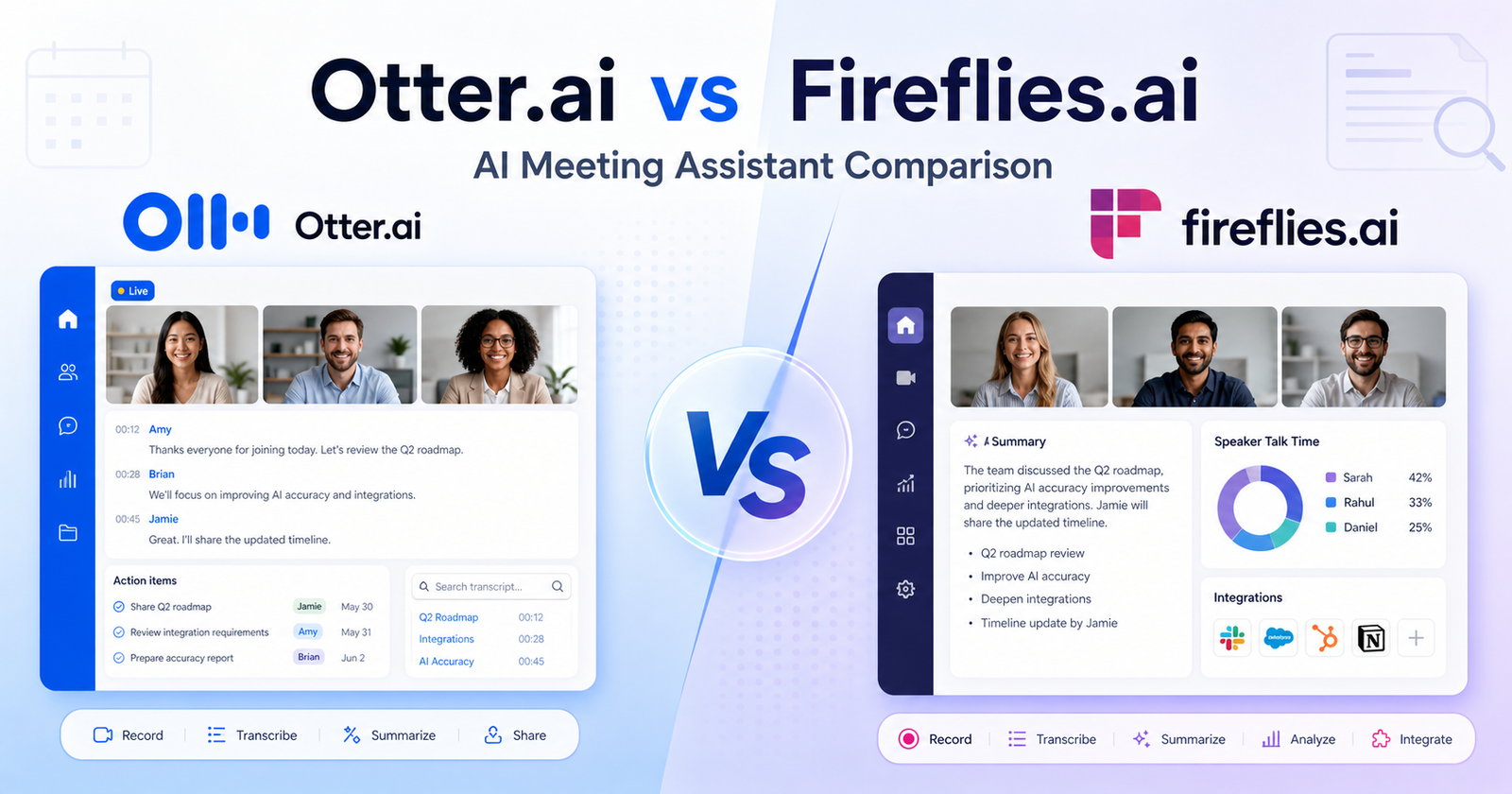
    Otter.ai is the better choice if you want live meeting transcription, simple meeting notes, calendar-based auto-join, and a cleaner experience for teams that need notes during the call. Fireflies.ai is the better choice if you want broader meeting intelligence, unlimited transcription on paid plans, stronger search across past meetings, more workflow integrations, and conversation analytics for teams.

    For most solo users who need basic live notes, Otter.ai feels easier to start with. For sales, recruiting, customer success, agencies, and teams that want transcripts to become a searchable knowledge base, Fireflies.ai usually offers more depth.

    Both tools are useful, but they solve slightly different problems. Otter.ai is strongest as a real-time AI notetaker. Fireflies.ai is strongest as a meeting intelligence system that records, transcribes, summarizes, searches, and connects meetings with the rest of your workflow.

    Quick Comparison

    Comparison Point Otter.ai Fireflies.ai
    Best for Live meeting notes, real-time transcription, and simple team sharing Meeting intelligence, searchable transcripts, analytics, and integrations
    Main workflow Connect calendar, let Otter Notetaker join meetings, follow live notes and summaries Invite Fireflies or let it autojoin, then search, summarize, analyze, and share meetings
    Meeting platforms Zoom, Microsoft Teams, and Google Meet Zoom, Google Meet, Microsoft Teams, and more meeting sources
    Live transcription Strong focus on real-time transcription and live meeting visibility Supports real-time notes and live transcriptions, with more post-meeting intelligence depth
    AI summaries Automated summaries, key takeaways, action items, and AI Chat Unlimited AI summaries on listed plans, AskFred assistant, AI apps, and action item workflows
    Search Search notes by keyword, speaker, and date Meeting search plus AskFred for querying meetings
    File uploads Basic has 3 lifetime imports; Pro has 10 monthly audio/video imports; Business lists unlimited imports Upload audio/video files, with storage limits by plan
    Storage Pro includes unlimited storage; Business focuses on unlimited meetings and recordings Free includes 400 minutes storage/team; Pro includes 8,000 minutes storage/seat; Business and Enterprise list unlimited storage
    Team features Team vocabulary, taggable speakers, admin features, usage analytics on higher plans Team analytics, user groups, conversation intelligence, channels, and collaboration workflows on higher plans
    Integrations Zoom, Teams, Google Meet, Slack, Google Drive, Salesforce, HubSpot, Zapier, and others Zoom, Google Meet, Teams, CRM and workflow integrations, API access, Chrome extension, desktop and mobile apps
    Analytics Usage analytics and admin controls on Business Talk-time analytics on Pro, team analytics and conversation intelligence on Business
    Mobile and desktop apps iOS and Android apps, plus Mac and Windows downloads Desktop app, mobile apps, and Chrome extension
    Admin/security fit Better as teams move into Business and Enterprise Stronger enterprise/admin direction with SSO + SCIM and rules engine on Enterprise
    Easiest starting point Otter Basic is straightforward for trying live meeting notes Fireflies Free is attractive if you want broad meeting capture and summaries with storage limits
    Overall recommendation Choose Otter.ai for live note-taking simplicity Choose Fireflies.ai for deeper searchable meeting intelligence

    Pricing Comparison

    Both tools publish plan-level pricing. Otter.ai prices around transcription minutes, meeting duration, imports, and team controls. Fireflies.ai prices around seats, storage, AI summaries, AI credits, analytics, and enterprise controls.

    Pricing Point Otter.ai Fireflies.ai
    Free plan Basic is Free Free is $0 forever
    Free plan limits 300 monthly transcription minutes and 3 lifetime audio/video file imports 400 minutes of storage/team, unlimited transcription, and unlimited AI summaries listed on the pricing page
    Lowest paid monthly plan Pro at $16.99/user/month Pro at $18/seat/month
    Lowest paid annual plan Pro at $8.33/user/month billed annually Pro at $10/seat/month billed annually
    Mid-tier monthly plan Business at $30/user/month Business at $29/seat/month
    Mid-tier annual plan Business at $19.99/user/month billed annually Business at $19/seat/month billed annually
    Enterprise plan Enterprise is available for large teams and companies Enterprise is $39/seat/month, annual only
    Paid transcription allowance Pro includes 1,200 in-app recording minutes; Business lists unlimited meetings and in-app recordings Paid plans list unlimited transcription and unlimited AI summaries
    Meeting length limits Pro supports up to 90 minutes/meeting; Business supports up to 4 hours/meeting Business adds video recording, multi-language mode, and conversation intelligence; the pricing page focuses more on storage and features than meeting-length caps
    File imports Basic includes 3 lifetime imports; Pro includes 10 monthly imports; Business lists unlimited imports Upload audio/video files is included; storage is 400 minutes/team on Free, 8,000 minutes/seat on Pro, and unlimited on Business/Enterprise
    AI assistant features AI Chat within and across meetings; AI meeting workflows AskFred AI assistant, AI Skills, AI summaries, action items, and task manager
    Team/admin features Business includes activity logs, usage analytics, prioritized support, and 3 concurrent meetings Business includes team analytics, user groups, conversation intelligence, and 30 AI credits
    Enterprise controls Enterprise is aimed at large teams and companies Enterprise includes rules engine and SSO + SCIM
    Best value path Otter Pro annual is the cheapest paid Otter path for individuals Fireflies Pro annual is the cheapest paid Fireflies path for individuals and small teams
    Tool Plan Monthly Price Annual Price Best For Key Limits Or Differences
    Otter.ai Basic Free Free Trying live meeting notes 300 monthly transcription minutes, 3 lifetime audio/video file imports
    Otter.ai Pro $16.99/user/month $8.33/user/month billed annually Individuals and small teams 1,200 in-app recording minutes, 10 monthly imports, up to 90 minutes/meeting
    Otter.ai Business $30/user/month $19.99/user/month billed annually Medium-sized teams Unlimited meetings and in-app recordings, unlimited imports, up to 4 hours/meeting, 3 concurrent meetings
    Otter.ai Enterprise Custom sales plan Custom sales plan Large teams and companies Enterprise deployment and advanced organization needs
    Fireflies.ai Free $0 $0 Individuals starting out 400 minutes storage/team, meeting search, AskFred, desktop/mobile/Chrome options
    Fireflies.ai Pro $18/seat/month $10/seat/month billed annually Professional individuals and small teams 8,000 minutes storage/seat, downloads, 20 AI credits, unlimited integrations
    Fireflies.ai Business $29/seat/month $19/seat/month billed annually Growing businesses Unlimited storage, video recording, conversation intelligence, team analytics, 30 AI credits
    Fireflies.ai Enterprise Annual only $39/seat/month billed annually Large-scale enterprises Rules engine, SSO + SCIM, enterprise controls

    Pricing sources checked: 2026-06-13. Sources: Otter.ai official pricing page and Fireflies.ai official pricing page.

    What Is Otter.ai?

    Otter.ai is an AI meeting assistant built around real-time transcription, meeting summaries, action items, and searchable meeting notes. Its official product pages emphasize live meeting support across Zoom, Microsoft Teams, and Google Meet, plus calendar connection so Otter Notetaker can join scheduled meetings automatically.

    The strongest part of Otter.ai is how direct the workflow feels. You connect your calendar, let Otter join the meeting, and get a live transcript while the conversation is happening. That makes it useful for people who want to follow the meeting in real time, review what was said, and share notes quickly afterward.

    Otter.ai also supports speaker identification, audio playback, team vocabulary, taggable speakers, advanced search, exports, and admin controls on higher plans. For teams that need a practical note-taking layer without building a complicated meeting intelligence workflow, Otter.ai is easy to understand.

    What Is Fireflies.ai?

    Fireflies.ai is an AI assistant for meetings, email, chat, and CRM workflows. It can join meetings, record conversations, transcribe them, generate summaries, and make meetings searchable. Its official site highlights the ability to invite Fireflies to meetings or let it autojoin calendar meetings.

    Fireflies.ai is broader than a simple notetaker. It includes AskFred, meeting search, transcript downloads on paid plans, talk-time analytics, AI Skills, action items, task management, integrations, team analytics, and conversation intelligence on higher plans.

    That makes Fireflies.ai a strong fit for teams that do not just want notes. They want to turn calls into follow-ups, CRM context, coaching insights, searchable team memory, and reusable meeting knowledge.

    Feature Comparison

    Otter.ai and Fireflies.ai overlap in the obvious areas: both can record meetings, transcribe conversations, summarize calls, and help teams review what happened. The difference is in emphasis.

    Otter.ai puts more weight on live meeting support. Its official help center describes Otter Notetaker as a meeting participant that can automatically join Zoom, Google Meet, and Microsoft Teams meetings and transcribe in real time. Otter is especially useful when participants want to follow notes during the call instead of waiting until after the meeting.

    Fireflies.ai puts more weight on post-meeting intelligence. It gives users meeting search, AskFred, downloads, analytics, AI credits, team controls, and a broader set of meeting capture surfaces. Its free and paid pricing pages also emphasize unlimited transcription and summaries, although storage and advanced features differ by plan.

    If your workflow is mostly personal notes, interviews, lectures, or internal calls, Otter.ai can feel more focused. If your workflow involves sales calls, customer calls, recruiting interviews, training sessions, or agency/client meetings, Fireflies.ai gives more structure for using the transcript later.

    Transcription And Meeting Notes

    Otter.ai is strong for live transcription. It supports real-time notes, speaker identification, audio recording playback, AI meeting workflows, and AI Chat within and across meetings. The live angle matters when you need immediate context, especially if people join late, miss a point, or want to follow the transcript while listening.

    Fireflies.ai also supports transcription and live notes, but its value increases after the meeting. Users can search meetings, ask questions with AskFred, download transcripts and summaries on paid plans, and use AI Skills to structure meeting outputs. This is helpful when the transcript becomes part of a team knowledge system.

    For a manager who wants a quick transcript of weekly team calls, Otter.ai is enough. For a sales team that needs call notes, CRM follow-up, talk-time insights, and reusable summaries, Fireflies.ai has the broader toolset.

    Integrations And Workflow Fit

    Otter.ai lists integrations with meeting and productivity tools such as Zoom, Google Meet, Microsoft Teams, Slack, Google Drive, Google Calendar, Google Docs, HubSpot, Salesforce, Jira, Notion, Asana, and Zapier. Its workflow is built around capturing the meeting and moving notes into the tools where work continues.

    Fireflies.ai also supports popular meeting platforms and workflow tools. Its pricing page mentions Zoom, Google Meet, Teams, Chrome extension support, desktop and mobile apps, API access, and unlimited integrations on Pro. Business adds stronger team and conversation intelligence features.

    If your team already relies on a simple calendar-to-notes workflow, Otter.ai may be easier to manage. If your team wants transcripts to feed sales, recruiting, operations, or internal knowledge workflows, Fireflies.ai is more flexible.

    Ease Of Use

    Otter.ai has the easier starting experience for many users. The product is familiar: record a meeting, see the transcript, get a summary, search later, and share notes. The pricing structure also makes it clear where individual users start and where team admin controls appear.

    Fireflies.ai has more moving parts. The extra features are useful, but teams may need to understand storage, AI credits, integrations, channels, analytics, and enterprise controls. That is not a weakness if you need the depth. It just means Fireflies.ai is less of a simple notepad and more of a meeting operations platform.

    For non-technical users, Otter.ai is often easier to explain. For operations-heavy teams, Fireflies.ai gives more control.

    Pros And Cons Of Otter.ai

    Otter.ai Pros

    • Strong real-time transcription focus for live meetings.
    • Works with Zoom, Microsoft Teams, and Google Meet.
    • Basic plan lets users try the core meeting-notes workflow for free.
    • Pro annual pricing is affordable for individual users.
    • Business plan adds admin features, usage analytics, prioritized support, and longer meetings.
    • Search, export, playback, speaker identification, and team vocabulary help teams clean up and reuse notes.

    Otter.ai Cons

    • Basic plan has a 300-minute monthly transcription limit.
    • Pro has a 90-minute per-meeting limit and 10 monthly file imports.
    • Fireflies.ai offers broader analytics and meeting intelligence features for some team workflows.
    • Heavy team use may push users toward Business or Enterprise.
    • It is strongest for meeting notes, not every advanced sales or conversation intelligence workflow.

    Pros And Cons Of Fireflies.ai

    Fireflies.ai Pros

    • Paid plans list unlimited transcription and unlimited AI summaries.
    • Strong search and AskFred assistant for querying meeting history.
    • Pro adds downloads, talk-time analytics, AI Skills, action items, and unlimited integrations.
    • Business adds video recording, conversation intelligence, team analytics, user groups, and unlimited storage.
    • Enterprise has a clear annual price and adds SSO + SCIM and rules engine.
    • Good fit for sales, recruiting, agencies, customer success, and operations teams.

    Fireflies.ai Cons

    • The product has more settings and concepts than a simple notetaker.
    • AI credits matter for advanced AI-powered actions, so teams should understand plan limits before rollout.
    • Free storage is limited to 400 minutes/team.
    • Users who mainly need simple live notes may find Fireflies.ai more than they need.
    • Enterprise is annual only on the official pricing page.

    Who Should Choose Otter.ai?

    Choose Otter.ai if your priority is live meeting transcription, simple meeting notes, and an easy workflow for Zoom, Google Meet, and Microsoft Teams. It is a good fit for consultants, managers, educators, interviewers, founders, and small teams that want fewer manual notes without building a complex meeting intelligence system.

    Otter.ai also makes sense if you care about live visibility. Being able to follow a transcript during a meeting is helpful for accessibility, late joiners, noisy calls, and fast discussions.

    The best Otter.ai buyer is someone who wants meetings captured clearly and shared quickly, with enough team controls available when the organization grows.

    Who Should Choose Fireflies.ai?

    Choose Fireflies.ai if meetings are a major source of business knowledge. It is especially useful for teams that need to search previous conversations, analyze calls, download transcripts, create action items, connect meeting data to workflows, and use AI to extract more value after the call ends.

    Fireflies.ai is a strong fit for sales teams, recruiting teams, customer success teams, agencies, consultants, and operations teams. These groups often need more than a transcript. They need summaries, follow-ups, coaching signals, CRM context, searchable archives, and team-level visibility.

    The best Fireflies.ai buyer is a team that sees meetings as data, not just notes.

    If meeting notes are part of a wider productivity workflow, our Notion AI vs ClickUp AI comparison comparison is a useful companion; teams automating follow-up work should also read Zapier vs Make comparison.

    Final Recommendation

    Otter.ai is the safer choice for users who want a clean AI meeting notetaker with strong live transcription and an easy learning curve. It is direct, practical, and well suited to individuals and teams that mostly need reliable meeting notes.

    Fireflies.ai is the stronger choice for teams that want meeting intelligence. Its paid plans are compelling for users who need unlimited transcription, searchable meeting history, analytics, AI assistant features, integrations, and team workflows.

    If you want live notes first, choose Otter.ai. If you want meeting knowledge and workflow depth after the call, choose Fireflies.ai.

    FAQs

    Is Otter.ai better than Fireflies.ai?

    Otter.ai is better if you want simple live transcription and meeting notes during calls. Fireflies.ai is better if you want searchable meeting intelligence, analytics, integrations, and stronger post-meeting workflows. The better choice depends on whether your priority is live note-taking or deeper meeting analysis.

    Is Fireflies.ai better than Otter.ai for sales teams?

    Fireflies.ai is often better for sales teams because it includes conversation intelligence, talk-time analytics, action items, team analytics, CRM-oriented workflows, and broad integrations on paid plans. Otter.ai can still work for sales notes, but Fireflies.ai is more built around turning calls into follow-up and team insight.

    Does Otter.ai have a free plan?

    Yes. Otter.ai Basic is free. The official pricing page lists 300 monthly transcription minutes and 3 lifetime audio/video file imports on Basic, along with meeting transcription, speaker identification, audio playback, multi-language support, and mobile apps.

    Does Fireflies.ai have a free plan?

    Yes. Fireflies.ai Free is listed at $0 forever. The official pricing page lists unlimited transcription, unlimited AI summaries, and 400 minutes of storage/team, plus features such as meeting search, AskFred, audio/video upload, desktop app, mobile apps, Chrome extension, and API access.

    Which tool is cheaper?

    For annual individual paid plans, Otter.ai Pro is listed at $8.33/user/month billed annually, while Fireflies.ai Pro is listed at $10/seat/month billed annually. For monthly billing, Otter.ai Pro is $16.99/user/month and Fireflies.ai Pro is $18/seat/month. Fireflies.ai Business annual pricing is slightly lower than Otter.ai Business annual pricing.

    Which tool is better for live transcription?

    Otter.ai is stronger for live transcription as a core product experience. Its official help center describes Otter Notetaker automatically joining Zoom, Google Meet, and Microsoft Teams meetings and transcribing in real time. Fireflies.ai also supports live notes, but it leans more heavily into post-meeting intelligence.

    Which tool has better analytics?

    Fireflies.ai has the stronger analytics story for most teams. Pro includes talk-time analytics, and Business adds team analytics and conversation intelligence. Otter.ai Business includes usage analytics and admin features, but Fireflies.ai is more focused on analyzing meetings and team conversations.

    Can both tools join Zoom, Google Meet, and Microsoft Teams?

    Yes. Otter.ai supports Zoom, Microsoft Teams, and Google Meet. Fireflies.ai also supports Zoom, Google Meet, Microsoft Teams, and more meeting sources. Both tools can reduce manual note-taking across common meeting platforms.

    Which tool is better for small teams?

    Otter.ai is better for small teams that want simple live notes and a low-friction meeting assistant. Fireflies.ai is better for small teams that want meeting search, action items, integrations, analytics, and more structured post-meeting workflows.

    Which tool is better for enterprise teams?

    Fireflies.ai provides clearer public Enterprise pricing at $39/seat/month billed annually and lists enterprise controls such as rules engine and SSO + SCIM. Otter.ai also offers Enterprise for large teams and companies, but public pricing is not listed as a fixed self-serve price.

    Does Fireflies.ai include unlimited transcription?

    The official Fireflies.ai pricing page lists unlimited transcription and unlimited AI summaries across Free, Pro, Business, and Enterprise. Storage, AI credits, downloads, analytics, and admin controls vary by plan.

    Does Otter.ai include unlimited meetings?

    Otter.ai Business lists unlimited meetings and in-app recordings. Otter.ai Pro includes 1,200 in-app recording minutes and up to 90 minutes per meeting. Basic includes 300 monthly transcription minutes.