Tag: AI Workspace

  • How to Build an AI Meeting Notes Workflow: Capture, Summarize, Assign, Follow Up

    How to Build an AI Meeting Notes Workflow: Capture, Summarize, Assign, Follow Up

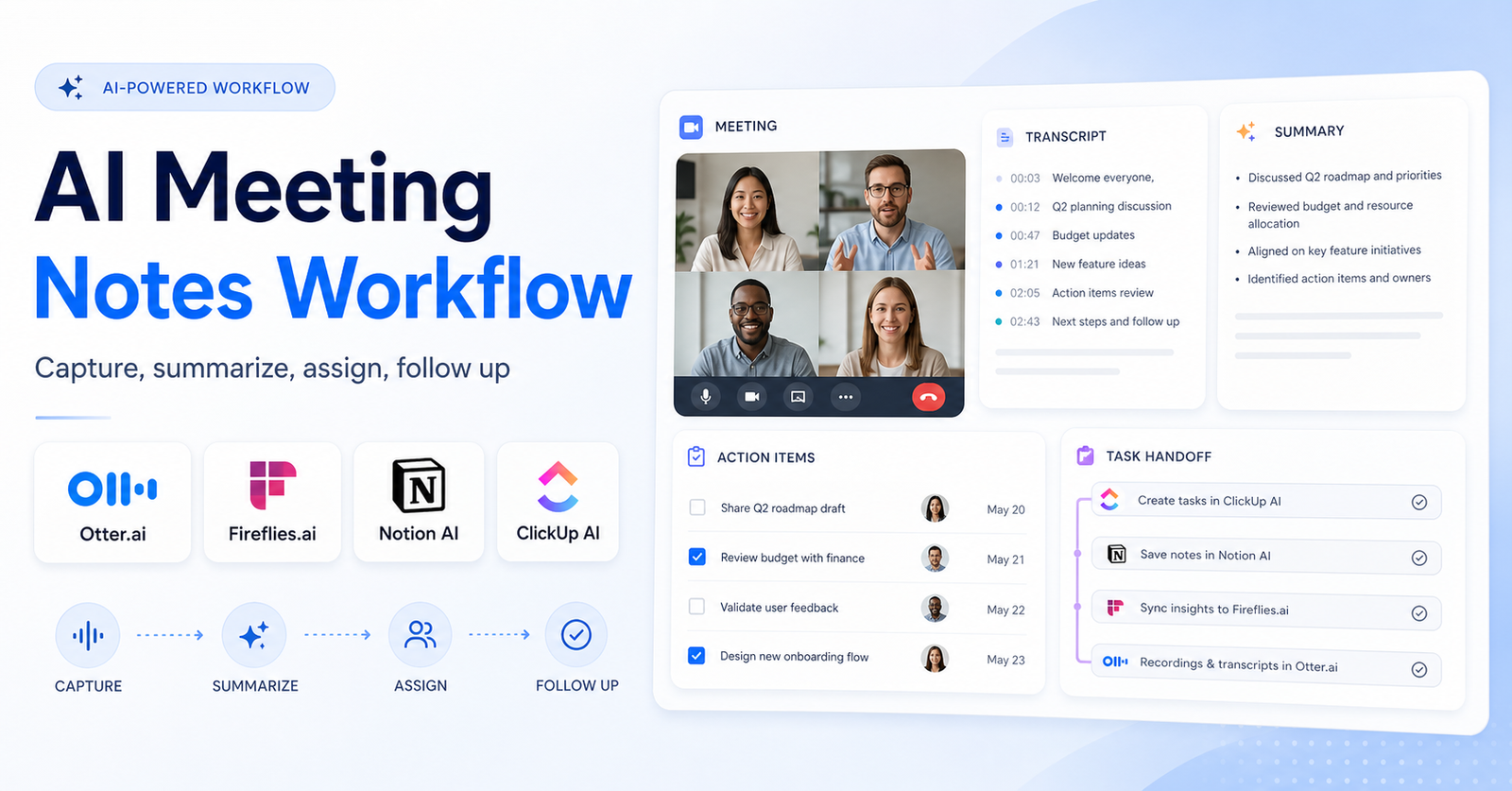
    An AI meeting notes workflow helps teams turn conversations into useful follow-up work. The goal is not just to record a transcript. The real value comes from capturing the meeting, summarizing decisions, assigning action items, sending follow-ups, and keeping the notes connected to the tools your team already uses.

    This matters because meetings often create hidden work. Someone promises to send a proposal. Someone else agrees to update a roadmap. A customer raises a risk. A manager asks for a decision by Friday. If those details stay buried in a call recording, the meeting still creates friction.

    A good workflow uses AI meeting assistants such as Otter.ai and Fireflies.ai for capture and summaries, then routes important notes into tools such as Notion AI, ClickUp AI, or your project management system. If you are deciding between the two main meeting assistants first, read our Otter.ai vs Fireflies.ai comparison. This guide focuses on the workflow around those tools.

    Quick Workflow Summary

    Step Purpose Output
    1. Define meeting types Decide which calls need AI notes Recording and note policy
    2. Capture the meeting Record transcript and speakers Searchable meeting record
    3. Generate a summary Extract decisions and key points Short team-readable notes
    4. Pull action items Identify owners, due dates, and next steps Task-ready checklist
    5. Store source notes Keep context in a shared workspace Reusable knowledge base
    6. Assign work Move tasks into the execution tool Clear owner and deadline
    7. Review and improve Check accuracy and close the loop Cleaner follow-up system

    1. Decide Which Meetings Need AI Notes

    Not every meeting needs a full AI notes workflow. Start by choosing which meeting types are worth capturing. Sales calls, customer onboarding sessions, hiring interviews, strategy meetings, product reviews, and recurring project check-ins usually benefit the most.

    For low-value calls, AI notes can create more noise than clarity. A short internal sync may only need a manual decision note. A client call with pricing, deadlines, objections, and commitments probably deserves a transcript, summary, and action-item workflow.

    Create a simple policy before connecting tools:

    • Which meetings can be recorded
    • Who should be notified before recording
    • Where transcripts and summaries are stored
    • Which meetings require human review
    • Who owns action-item cleanup
    • How long meeting records should be retained

    This makes the workflow more reliable and avoids treating AI recording as an afterthought.

    2. Capture The Meeting With The Right Tool

    The capture tool should fit the meeting environment. Otter.ai is commonly used for recording, transcription, summaries, and collaboration around meeting notes. Fireflies.ai is also built for meeting transcription, summaries, search, and workflow integrations.

    The right choice depends on where your team meets, how many calls you record, how you search past meetings, and whether your follow-up process depends more on notes, CRM updates, or project tasks.

    Before rolling it out broadly, test the tool on five real meetings. Review transcript quality, speaker labels, summary usefulness, permissions, calendar behavior, integrations, and how easy it is to find a specific decision one week later.

    3. Turn Transcripts Into Short Summaries

    A transcript is useful for auditability, but most team members will not read a full transcript. The workflow should produce a short summary that answers the obvious questions:

    • What was discussed?
    • What decisions were made?
    • What risks or blockers came up?
    • What should happen next?
    • Who owns each next step?

    This is where AI meeting assistants can save real time. Still, summaries should be reviewed before they are sent to clients, executives, or public-facing teams. AI can miss nuance, assign the wrong owner, or make a soft discussion sound like a firm commitment.

    A good summary should be short enough to scan in under one minute. If the meeting needs deep context, link back to the transcript or source notes rather than stuffing everything into the summary.

    4. Extract Action Items Separately

    Action items should not be hidden inside a paragraph summary. They need their own section with owner, task, due date, and context. If the AI cannot confidently identify the owner or deadline, mark it as unassigned instead of guessing.

    A clean action-item format looks like this:

    Owner Action Item Due Date Source Context
    Sarah Send revised onboarding checklist Friday Client asked for implementation steps
    Ahmed Confirm analytics access Before next call Reporting dashboard is blocked
    Team Decide between two workflow options Next planning meeting Product owner asked for tradeoff review

    The source context matters. A task without context becomes another vague to-do. Context helps the owner understand why the task exists.

    5. Store Meeting Knowledge In A Workspace

    Meeting notes become more valuable when they are stored in a searchable workspace. Notion AI Meeting Notes can help teams capture and organize notes inside a Notion workspace. ClickUp also offers an AI Notetaker workflow for turning meetings into summaries, action items, and connected work.

    If your team already uses Notion, the workspace can become the source of truth for meeting notes, decisions, and project context. If your team runs execution in ClickUp, moving action items into ClickUp may reduce handoff friction.

    For a broader workspace decision, our Notion AI vs ClickUp AI comparison can help clarify which system fits your team better.

    6. Assign Tasks Where Work Actually Happens

    A meeting note is not complete until the follow-up task lives where the team works. If your team uses ClickUp, create ClickUp tasks. If your team uses Notion, add tasks or database items. If your team uses a CRM, move customer follow-ups into the CRM.

    Avoid building a workflow where action items live in five places. That creates confusion and makes it hard to know whether the task was completed. The meeting assistant should capture and summarize; the execution tool should track ownership and deadlines.

    For automation-heavy teams, a tool such as Zapier or Make can help route notes into the right destination. Our Zapier vs Make comparison is useful if you want to automate handoffs between meeting notes, task tools, CRMs, and documents.

    7. Create A Review Loop

    AI notes need a review loop, especially for high-stakes meetings. The reviewer does not need to rewrite everything. They should check the summary, decisions, action items, owners, deadlines, sensitive details, and any client-facing language.

    A simple review checklist works well:

    • Is the summary accurate?
    • Are the action items clear?
    • Are owners correct?
    • Are deadlines real or guessed?
    • Does any private information need removal?
    • Are follow-up messages ready to send?
    • Were tasks created in the correct system?

    This is also where the team improves the workflow. If summaries are too long, change the prompt. If action items are vague, update the template. If notes are ignored, move them closer to the team's daily work.

    Recommended Tool Roles

    Otter.ai

    Use Otter.ai when your team needs meeting transcription, summaries, collaboration around notes, and a searchable meeting record. It is useful for recurring meetings, interviews, customer calls, and internal discussions where the transcript may need to be reviewed later.

    Fireflies.ai

    Use Fireflies.ai when meeting notes need strong search, summaries, and integrations with follow-up workflows. It can be useful for sales, customer success, recruiting, and cross-functional teams that want meeting intelligence connected to other systems.

    Notion AI

    Use Notion AI when meeting notes should become part of a broader knowledge base. It is helpful when teams already document projects, decisions, briefs, and research inside Notion.

    ClickUp AI

    Use ClickUp AI when meeting notes need to become tasks, project updates, or work items. It is a strong fit when your team already manages delivery, deadlines, owners, and project status inside ClickUp.

    Common Mistakes To Avoid

    The biggest mistake is stopping at transcription. A transcript alone does not guarantee follow-up. The workflow needs summaries, action items, storage, task assignment, and review.

    Avoid these mistakes:

    • Recording every meeting without a purpose
    • Sending summaries without checking accuracy
    • Letting AI guess owners or deadlines
    • Storing notes where nobody searches
    • Creating tasks in a tool the team does not use
    • Treating meeting notes as a replacement for project management
    • Keeping sensitive or private details longer than needed

    AI should reduce meeting admin, not create a second layer of messy documentation.

    Best AI Meeting Notes Workflow Template

    Use this template for recurring team meetings:

    1. Add the AI meeting assistant only to meetings that need a record. 2. Notify participants that the meeting may be recorded or summarized. 3. Capture transcript, speakers, summary, and action items. 4. Review the summary within 24 hours. 5. Move action items into the team's execution tool. 6. Store the summary in the project workspace. 7. Link the meeting note to the related project, client, or decision. 8. Send a short follow-up message to stakeholders. 9. Review unfinished action items before the next meeting. 10. Improve the template based on repeated misses.

    If your team also uses meeting notes as research input, pair this workflow with our AI research workflow for teams so transcripts become useful source material instead of forgotten recordings.

    Final Verdict

    The best AI meeting notes workflow is simple: capture the meeting, summarize the important points, extract action items, store the source notes, assign tasks in the right tool, and review before follow-up.

    Otter.ai and Fireflies.ai are strong capture tools. Notion AI and ClickUp AI are stronger as workspace and execution layers. The best setup is not the tool with the longest feature list. It is the setup that turns conversations into clear, completed work.

    FAQs

    What is an AI meeting notes workflow?

    An AI meeting notes workflow is a repeatable process for recording meetings, creating summaries, extracting action items, storing notes, assigning tasks, and reviewing follow-up work.

    Which AI tool is best for meeting notes?

    Otter.ai and Fireflies.ai are two common options for AI meeting notes. The better choice depends on your meeting platform, transcript quality needs, search requirements, integrations, and follow-up workflow.

    Should AI meeting notes replace manual notes?

    AI meeting notes can reduce manual note-taking, but they should not remove human review. Important decisions, owners, and deadlines should still be checked by a person.

    Can AI meeting tools create action items?

    Yes, many AI meeting tools can identify action items. Teams should review the owner, due date, and context before treating those action items as final.

    Where should AI meeting notes be stored?

    Store meeting notes where your team already works. That may be Notion, ClickUp, a CRM, a project management tool, or a shared documentation system.

    Are AI meeting notes accurate?

    Accuracy depends on audio quality, speakers, accents, meeting structure, and the tool. Always review summaries and action items before sending them to clients or leadership.

    Should every meeting be recorded?

    No. Record meetings only when there is a clear business reason, and make sure participants understand the recording or note-taking policy.

    How do teams use AI meeting notes after the call?

    Teams can use AI meeting notes to send recap emails, update CRMs, create project tasks, document decisions, and prepare for the next meeting.

    Can AI meeting notes connect to project management tools?

    Yes. Some tools offer direct integrations, and teams can also use automation platforms to move notes and tasks into project management systems.

    What is the biggest risk with AI meeting notes?

    The biggest risk is trusting summaries without review. AI can miss nuance, assign the wrong owner, or turn a discussion into a decision that was never actually made.
  • Notion AI vs ClickUp AI: Which AI Workspace Tool Should You Choose?

    Notion AI vs ClickUp AI: Which AI Workspace Tool Should You Choose?

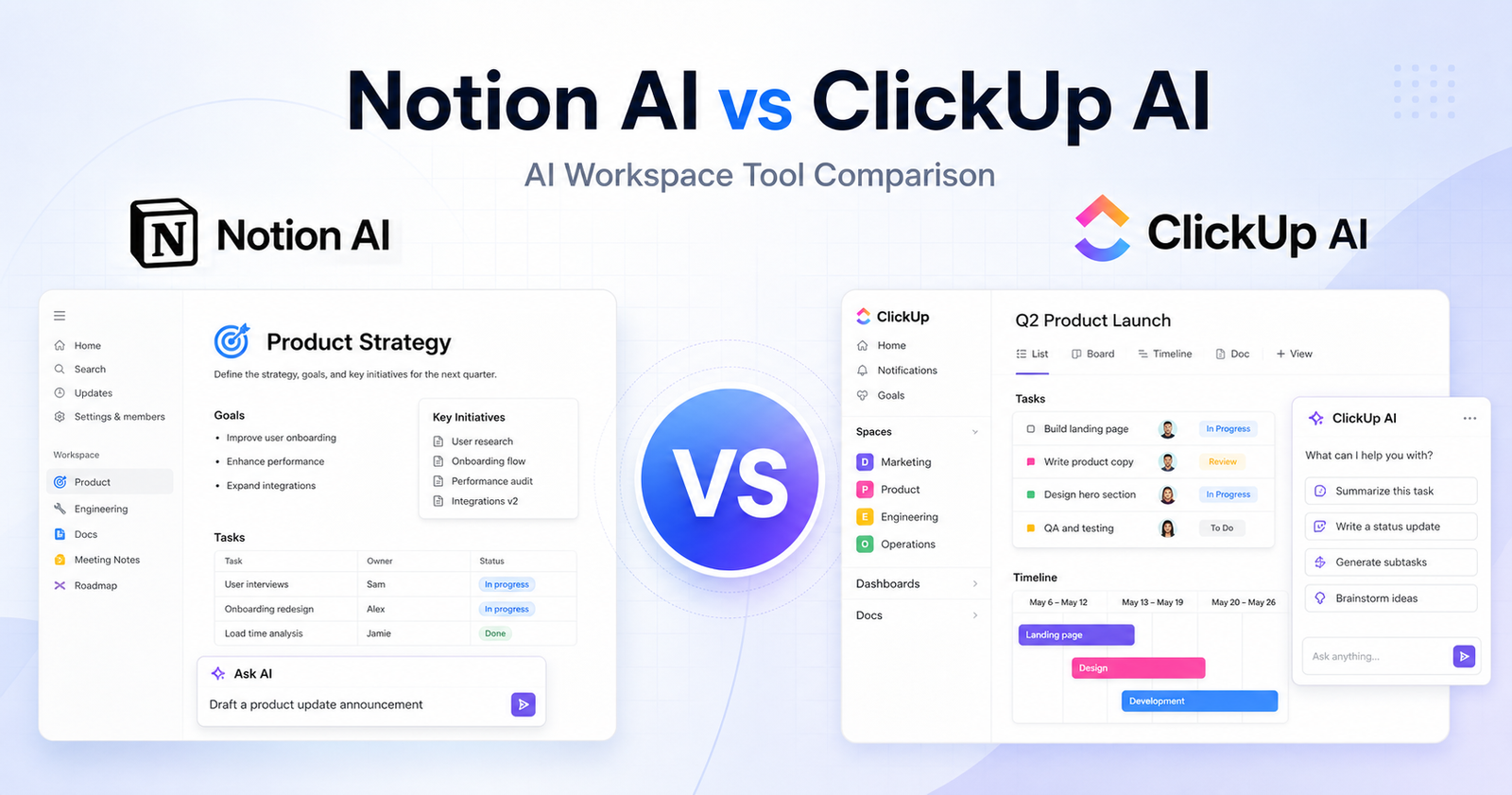
    If you are comparing Notion AI vs ClickUp AI, the real question is not simply which assistant writes better text. Notion AI is strongest when your work lives in docs, wikis, notes, databases, and knowledge hubs. ClickUp AI, now branded around ClickUp Brain, is stronger when your work is already organized around tasks, projects, goals, docs, dashboards, and team execution.

    Both tools can summarize, draft, answer questions, and help teams move faster. The better choice depends on where your team keeps its source of truth and whether you need an AI workspace for knowledge management or an AI layer for project delivery.

    Quick Verdict

    Choose Notion AI if you want an AI assistant inside a flexible workspace for notes, documentation, databases, meeting notes, lightweight projects, and company knowledge. It is especially good for teams that already use Notion as a wiki or operating system.

    Choose ClickUp AI if you want AI connected to tasks, projects, docs, comments, meetings, dashboards, and execution workflows. It is usually the better fit for teams that need project management, accountability, and cross-functional delivery in one place.

    Quick Comparison

    Category Notion AI ClickUp AI
    Best for Docs, wikis, notes, databases, knowledge management Tasks, projects, docs, dashboards, team execution
    Core workspace style Flexible blocks and databases Structured project management with tasks and views
    AI brand Notion AI, Notion Agent, AI Meeting Notes, Enterprise Search, Custom Agents ClickUp Brain and Everything AI
    Writing help Strong for drafting, rewriting, summaries, notes, and documentation Strong for task updates, docs, comments, summaries, and project communication
    Knowledge answers Works well when your content is organized in Notion pages and databases Useful when work context lives across tasks, docs, comments, and connected project spaces
    Project management Lightweight to moderate, depending on database setup Native project management with tasks, lists, boards, timelines, goals, and dashboards
    Meeting support AI Meeting Notes available on Business and Enterprise plans AI meeting and task context features are part of the broader Brain workflow
    Automation fit Good for database workflows and knowledge organization Better for operational workflows, task updates, and team execution
    Free access Free plan available, with AI trials noted on the pricing page Free Forever plan available, with AI available as paid add-ons
    Best team type Founders, content teams, research teams, documentation-heavy teams Agencies, operations teams, product teams, marketing teams, and project-heavy companies

    Pricing Comparison

    Both products use workspace pricing plus AI-related plan or add-on options. Here is the verified plan data available from official pricing pages used for this comparison.

    Pricing Point Notion AI ClickUp AI
    Free plan Free plan at $0 Free Forever plan at $0
    Entry workspace plan Plus at $10 per seat/month in the USD pricing data Unlimited at $7 per user/month billed yearly, with monthly pricing also shown as $10 per user/month
    Business workspace plan Business at $20 per seat/month in the USD pricing data Business at $12 per user/month billed yearly
    Enterprise plan Enterprise custom plan Enterprise custom plan
    AI add-on / AI product pricing Notion pricing includes AI trials and separate AI products including Notion Agent, AI Meeting Notes, Enterprise Search, and Custom Agents credit-based usage ClickUp Brain at $9 per user/month; Everything AI at $28 per user/month
    Meeting notes AI Meeting Notes included on Business and Enterprise in the pricing data Meeting and workspace intelligence are positioned inside ClickUp Brain / Everything AI
    Custom AI usage Custom Agents pricing is credit-based, with $10 per 1,000 credits shown in the pricing data Enterprise and higher AI needs may use ClickUp’s custom workspace and AI options
    Main pricing advantage Lower listed Business workspace plan in the captured USD data Clear AI add-on pricing for Brain and Everything AI
    Main pricing tradeoff Advanced AI and custom agents can add complexity beyond the base workspace plan ClickUp can become more expensive when every user needs paid AI plus project management seats

    Notion AI Overview

    Notion is a flexible workspace built around pages, blocks, databases, templates, and collaborative documentation. Notion AI adds an assistant layer that can help draft content, summarize pages, answer questions from workspace knowledge, improve writing, and support meeting or research workflows.

    The biggest strength of Notion AI is that it sits close to your knowledge base. If your team stores SOPs, meeting notes, strategy docs, product specs, content calendars, or client notes in Notion, the assistant can make that information easier to reuse.

    Notion also works well for teams that like to design their own systems. A content team can build an editorial database. A startup can build an investor CRM. A research team can maintain a source library. Notion AI then supports the written and knowledge-heavy parts of those workflows.

    ClickUp AI Overview

    ClickUp is a work management platform built around tasks, lists, projects, docs, goals, dashboards, calendars, whiteboards, and automations. ClickUp AI is now centered on ClickUp Brain, which connects AI assistance to the work already happening inside ClickUp.

    The main advantage is execution context. ClickUp does not only hold documents; it also holds owners, deadlines, priorities, comments, statuses, dependencies, and project history. That makes its AI more useful for teams that want summaries, action items, project updates, task generation, and operational clarity.

    ClickUp is less open-ended than Notion, but that structure is often the point. If your team needs visibility across projects, ClickUp gives you more native controls than a Notion database setup.

    AI Writing and Documentation

    Notion AI feels natural for long-form writing, internal documentation, meeting notes, brainstorming, and knowledge cleanup. It is helpful when you want to turn rough notes into a polished doc, rewrite a paragraph, summarize a strategy page, or create a first draft inside a workspace.

    ClickUp AI is also capable at writing, but its writing feels more connected to execution. It is useful for drafting task descriptions, summarizing comment threads, creating project updates, turning notes into action items, and improving team communication.

    For pure documentation and knowledge reuse, Notion AI is easier to recommend. For writing tied to projects and task movement, ClickUp AI usually has the stronger practical context.

    Project Management and Team Execution

    This is where the two tools separate clearly.

    Notion can manage projects through databases, board views, calendar views, templates, and custom properties. It is flexible and lightweight, but it requires more setup discipline. If your team wants a custom project hub that also stores research and docs, Notion is excellent.

    ClickUp is built for project management from the start. Tasks, assignees, due dates, priorities, statuses, dependencies, time tracking, dashboards, and workload views are native parts of the platform. ClickUp AI benefits from that structure because it can help summarize and move work that already has operational metadata.

    If your team misses deadlines because work is scattered, ClickUp AI is the stronger option. If your team mainly needs better knowledge organization and writing support, Notion AI may feel cleaner.

    Knowledge Management

    Notion AI is one of the stronger choices for teams that think in pages, knowledge bases, and reusable systems. It is comfortable for wikis, product docs, research notes, training libraries, content briefs, and company handbooks.

    ClickUp can also store docs and knowledge, but its knowledge management is usually attached to tasks and projects. That is useful for execution-heavy teams but may feel heavier if your main goal is a clean internal wiki.

    A simple rule: if the knowledge itself is the product, choose Notion. If the knowledge exists to move projects forward, choose ClickUp.

    Pros and Cons

    Notion AI Pros

    • Excellent fit for documentation-heavy teams
    • Flexible workspace for notes, databases, wikis, and content systems
    • Strong writing, summarizing, and knowledge-assistant use cases
    • Clean interface with less project-management overhead
    • Good for founders, creators, researchers, and internal knowledge teams

    Notion AI Cons

    • Project management requires more custom setup
    • Less native structure for complex task operations
    • Advanced AI products and custom agents can add pricing complexity
    • Teams may need strong workspace governance to avoid messy databases

    ClickUp AI Pros

    • Strong fit for project-heavy teams
    • AI is connected to tasks, docs, comments, deadlines, and work status
    • Better native project management than Notion
    • Useful for agencies, marketing teams, product teams, and operations teams
    • Clear AI add-on pricing for Brain and Everything AI

    ClickUp AI Cons

    • More complex interface than Notion for simple documentation workflows
    • AI costs can rise when many users need paid AI access
    • Less elegant as a pure notes or wiki tool
    • Teams that only need writing help may not need ClickUp’s full work management stack

    Which Tool Should You Choose?

    Choose Notion AI if your priority is building a flexible knowledge workspace. It is the better pick for documentation, research notes, content planning, internal wikis, meeting notes, and custom databases. It is especially strong when your team wants a calm place to think, write, organize, and reuse information.

    Choose ClickUp AI if your priority is managing work from idea to completion. It is better for task-heavy teams, agencies, product teams, marketing teams, and operations groups that need AI connected to deadlines, statuses, owners, comments, and project reporting.

    For many small teams, the choice comes down to your main pain point. If information is hard to find, Notion AI is likely the cleaner answer. If work is hard to track, ClickUp AI is likely the stronger answer.

    FAQs

    Is Notion AI better than ClickUp AI?

    Notion AI is better for documentation, knowledge management, research notes, and flexible databases. ClickUp AI is better for structured project work, task management, and team execution.

    Is ClickUp AI good for project management?

    Yes. ClickUp AI is strongest when it can work with tasks, comments, docs, deadlines, assignees, and project updates inside ClickUp.

    Does Notion have a free plan?

    Yes. Notion lists a Free plan at $0, plus paid workspace plans including Plus, Business, and Enterprise.

    How much does ClickUp Brain cost?

    ClickUp’s pricing page lists ClickUp Brain at $9 per user/month and Everything AI at $28 per user/month.

    Which tool is better for a company wiki?

    Notion AI is usually better for a company wiki because Notion’s page and database model is designed around flexible documentation and knowledge hubs.

    Which tool is better for agencies?

    ClickUp AI is usually better for agencies that need tasks, owners, deadlines, statuses, dashboards, and client delivery workflows. Notion AI can still work well for agency documentation and knowledge bases.

    If your productivity stack also includes scheduling or meeting notes, our Motion vs Reclaim AI comparison and Otter.ai vs Fireflies.ai comparison guides are natural follow-up comparisons.

    Final Verdict

    Notion AI and ClickUp AI are both useful, but they solve different workspace problems. Notion AI is the better AI knowledge workspace. ClickUp AI is the better AI project execution workspace.

    If your team lives in docs and databases, choose Notion AI. If your team lives in tasks, timelines, dashboards, and delivery workflows, choose ClickUp AI.