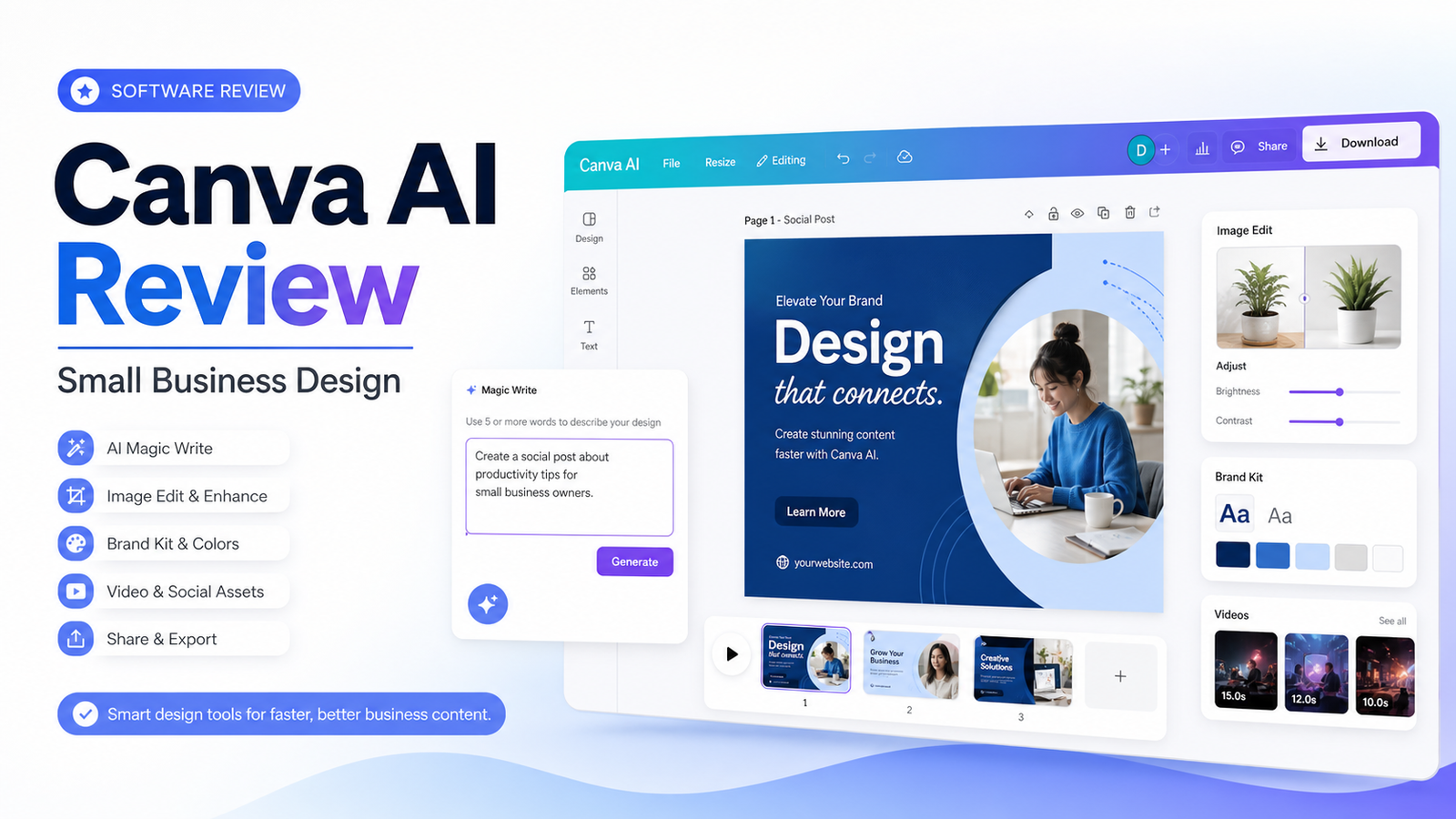
Canva AI is part of Canva's broader design workspace, so it should be reviewed as a practical design assistant rather than a standalone image generator. For small businesses, the real value is creating on-brand social graphics, presentations, simple videos, ads, flyers, and content drafts faster while keeping human review in place.
Quick Verdict
Canva AI is worth considering for small businesses that already use Canva or need one accessible workspace for branded design, social content, presentations, and light marketing assets. It is less suitable when the team needs advanced professional design control, complex image editing, or guaranteed brand-safe output without review.
Best For
- Small businesses creating frequent social and marketing assets.
- Teams that need brand kits, templates, presentations, and quick exports.
- Non-designers who need an approachable design workflow.
- Marketers who will review AI text, layouts, and images before publishing.
Not Best For
- Professional design teams needing advanced layout or image control.
- Brands with strict compliance workflows but no approval process.
- Users expecting perfect AI-generated designs without editing.
- Businesses that need verified logos, claims, or product shots generated from scratch.
Our Evaluation Criteria
Ease of use
The tool should let non-designers create useful drafts without breaking brand consistency.
Brand control
Brand kits, templates, and asset libraries matter more than one-off AI effects.
AI feature usefulness
Text, image, layout, and video tools should reduce real work after review.
Collaboration
Comments, approvals, folders, and team permissions matter for repeatable production.
Export quality
Check the formats, dimensions, and compression required for each channel.
Pricing
Compare Free, Pro, Teams, Enterprise, AI credits, brand features, and storage from official sources.
Key Features And Capabilities
Magic Studio
A set of AI-assisted tools for writing, design, image editing, and creative production.
Brand Kit
Centralizes brand colors, fonts, logos, and templates for more consistent assets.
Templates
Provides a large template library for social, presentation, video, print, and marketing uses.
Collaboration
Teams can comment, share designs, and organize work when folder structure is maintained.
Exports
Canva supports common export formats for social, web, video, and print-oriented workflows.
Real Use Cases
Social content
A small business can draft posts, resize formats, and keep brand colors consistent.
Presentations
A founder can build a simple pitch or webinar deck and verify every claim before sharing.
Ad creative
A marketer can produce ad variations, then check offer accuracy and platform requirements.
Email graphics
Teams can create campaign headers and product visuals from approved assets.
Local marketing
A service business can create flyers, menus, posters, or event assets using templates and review.
Comparison Table
| Option | Best For | Main Strength | Important Limitation |
|---|---|---|---|
| Canva AI | Small-business design | Accessible templates and AI tools | Not full professional design software |
| Adobe Express | Quick branded content | Adobe ecosystem and templates | Different asset workflow |
| Adobe Firefly | Generative image creation | Creative generation and Adobe integration | Less all-in-one template workflow |
| Figma | Product and interface design | Collaboration and design systems | Higher design skill requirement |
| VistaCreate | Template-based marketing assets | Simple social design | Different AI depth |
Pricing
Canva publishes Free, Pro, Teams, Enterprise, and education/nonprofit paths on its official pricing page. Current plan value depends on users, brand kits, premium assets, AI tools, storage, collaboration, and billing period. Use the official pricing page before purchasing.
Pricing last checked on June 28, 2026. Pricing may vary by region, billing period, users, contacts, tasks, credits, storage, usage, or add-ons. Use the linked official pricing page for the current purchase decision.
Pros
- Helps reduce repetitive work when source material is reliable.
- Supports faster drafting, organization, or handoff in a defined workflow.
- Gives teams a clearer structure for evaluating software choices.
- Can improve consistency when ownership, review, and templates are maintained.
Cons And Limitations
- Output quality depends on inputs, configuration, and review discipline.
- Pricing models are not directly comparable across vendors.
- Migration, administration, and training still require time.
- Human review remains necessary for facts, commitments, and sensitive decisions.
Alternatives
Compare the listed products with systems the team already owns. A simpler document, shared inbox, CRM workflow, project tool, or manual process may be better when volume is low. Specialist software may be necessary when the workflow requires regulated records, advanced analytics, or deep transactional controls.
A Practical 30-Day Evaluation Plan
Week 1: Define The Workflow
Choose one recurring workflow with a clear owner, approved inputs, a known output, and a human review step. Record how the work is completed today, how long it takes, where errors occur, and which systems are involved. This baseline is essential. Without it, a team can mistake novelty for improvement and buy a product that adds another interface without removing meaningful work.
Document the data the workflow uses. Mark which information is public, internal, confidential, regulated, outdated, duplicated, or missing. Confirm which users should have access. AI features cannot repair contradictory records or unclear permission boundaries. In many projects, cleaning documentation, contact data, creative assets, deal records, or task ownership creates more value than adding another subscription.
Week 2: Run In Parallel
Use the new tool alongside the existing process. Review every output rather than allowing automatic publication or action. Label corrections as factual, contextual, formatting, tone, permission, missing information, incorrect action, or missing context. This creates a useful evidence set and reveals whether the product reduces work after review.
Test normal and difficult cases. Include incomplete inputs, ambiguous instructions, changed requirements, unsupported file types, poor audio, unusual customer requests, unusual sales cycles, or edge cases relevant to the category. A polished demo often hides the exact conditions that make daily work difficult.
Week 3: Improve The System
Update source documents, templates, prompts, routing rules, integrations, naming conventions, and permissions based on observed failures. Remove steps that do not improve the outcome. If users bypass the workflow, determine whether the cause is poor fit, missing training, slow performance, inadequate integration, or a review process heavier than the original task.
Define escalation. State which actions the software may assist with, which actions require approval, and which requests must always go to a qualified person. Legal interpretations, employment decisions, financial commitments, security incidents, customer exceptions, and public claims should not be hidden behind a confident AI answer.
Week 4: Measure And Decide
Compare the pilot with the baseline. Review completion time, editing time, error rate, adoption, administrator workload, integration reliability, and expected annual cost. Include seats, contacts, tasks, credits, storage, implementation, training, and the cost of correcting mistakes. A low entry price can be misleading when the usable workflow requires higher tiers or extensive manual review.
Decide whether to expand, keep the workflow limited, change configuration, evaluate an alternative, or stop. Write down the decision and assumptions. Revisit them when prices, product capabilities, data requirements, or business volume change.
Security, Governance, And Quality Control
Use least-privilege access and multifactor authentication. Assign an account owner, billing owner, workflow owner, and output reviewer. Confirm retention, export, deletion, model-training, integration, and administrator controls from current vendor documentation. Do not paste confidential customer, employee, financial, legal, security, or product information into an unapproved account.
Keep a human in control of high-impact outputs. Verify names, dates, prices, links, calculations, commitments, claims, permissions, and citations. For automated actions, use bounded permissions, monitoring, logs, alerts, and a tested rollback or correction process. The team should know how to pause a workflow quickly.
How To Measure Value
Measure time saved after review, not before it. Track correction rates, handoff errors, turnaround time, user adoption, administrator work, and whether approved outputs reach the correct system of record. For customer-facing workflows, monitor complaints, escalations, missed requests, and quality sampling. For content, sales, or meeting work, measure revision time, consistency, and whether the final result serves the intended audience.
Model twelve-month cost. Include subscription fees, users, contacts, tasks, credits, storage, integrations, implementation, training, and maintenance. Also confirm how data and configurations can be exported if the tool no longer fits. A responsible software decision includes a practical exit path.
Detailed Decision Checklist
Write down the exact problem in one sentence before comparing plans. A useful statement names the workflow, the current friction, the expected improvement, and the owner. "We need AI" is not a buying requirement. "Our sales lead needs a forecast view based on consistent CRM stages, close dates, deal notes, and human-reviewed risks" is specific enough to test.
List required integrations and decide which system remains authoritative. A design assistant may create drafts, but approved brand assets still need an owner. A presentation tool may produce slides, but sales and finance numbers need a verified source. A workspace tool may help people find answers, but source owners must update policy. An automation platform can move data, but it should not become the only place where business logic is understood.
Review failure handling. Ask what happens when an integration disconnects, a credit limit is reached, an upload fails, a transcript is wrong, a source is outdated, or a user loses access. Define alerts, owners, correction steps, and acceptable downtime. A workflow that succeeds in ideal conditions but fails silently is not production-ready.
Check administration from the perspective of the future owner. The person evaluating the product may not be the person maintaining it six months later. Require clear names, documentation, change history, permission review, billing visibility, and an onboarding process for new users. Test whether a second person can understand the setup without relying on the original builder.
Finally, inspect the exit path. Confirm export formats, media or document ownership, API access where relevant, deletion procedures, and the effort required to move to another system. Record contract renewal dates and who receives billing notices. The ability to leave reduces operational risk and creates a more honest comparison of long-term cost.
Questions To Ask Before Approval
- Which approved sources or records does the workflow depend on?
- Who reviews the output, and what must that reviewer check?
- Which actions can occur automatically, and which require confirmation?
- How are errors, outages, and exhausted limits reported?
- What data is retained, where is it stored, and how is it deleted?
- What will the workflow cost at expected twelve-month volume?
- Can another employee maintain it from the documentation?
- How will the team export its data and configuration if it leaves?
Common Buying Mistakes
- Selecting a product from a feature list without testing a real workflow.
- Comparing entry prices without modeling users, volume, credits, storage, and add-ons.
- Treating generated text, summaries, recommendations, or actions as verified facts.
- Expanding before permissions, review, escalation, and ownership are documented.
- Buying software to compensate for missing process, poor data, or unclear accountability.
- Assuming every AI-labelled feature produces measurable business value.
Final Recommendation
Use Canva AI when the business needs an accessible design workspace with templates, brand controls, and practical AI assistance. Keep a review step for facts, offers, brand usage, image rights, and final dimensions. Designers may still prefer specialist tools for complex work.
Frequently Asked Questions
What is the best option?
The best option is the one that fits the real workflow, data, users, administration, and budget.
Is there a free plan?
Many products in this category offer a free path or trial, but current limits should be checked on the official pricing page.
Can AI replace human review?
No. Important facts, actions, claims, and decisions require accountable review.
How should pricing be compared?
Model the required plan, users, credits or volume, integrations, implementation, and maintenance.
How long should a pilot run?
A focused two-to-four-week pilot is usually enough to identify workflow fit and failure modes.
What is the biggest risk?
Poor source data, unclear permissions, and unreviewed outputs create more risk than the interface itself.
Related Dailytimespro Guides
See our Canva AI pricing, Canva AI vs Adobe Firefly, Gamma vs Canva AI.
Leave a Reply